World
Lorenzo Maria Pacini
September 6, 2026
© Photo: Public domain

The infrastructure of the multipolar world is not only physical but also, and increasingly, digital.

X

Contact us: @worldanalyticspress_bot

From physical space to information space

Those who study Eurasian integration tend to measure it in kilometers of railroad track and metric tons of cargo moved. It is a legitimate measure, but an incomplete one. In the 21st century, connectivity is not just about roads, railways, and ports: it is about data, telecommunications, artificial intelligence, cloud infrastructure, digital payments, cybersecurity, and information networks. A rail corridor connects cities and markets on a physical level; a digital corridor connects economies through information flows. The SCO has begun to work systematically on this second type of corridor, and the stakes are higher than the infrastructure rhetoric suggests.

The Organization’s digital dimension has a recognizable institutional birthdate. It dates back to the “Concept of Cooperation on Digitalization and ICT” (drafted as early as 2019), followed by programs on digital literacy and artificial intelligence and, recently, by an Action Plan for Digital Transformation.  At the Tianjin summit in September 2025, members adopted a specific declaration on strengthening cooperation in the digital economy, calling for the development of digital infrastructure, public digital infrastructure, next-generation communications, and reliable data transmission, while also promoting cooperation on data privacy and information security. What is significant is not the list of areas, but the shift in their status: the digital dimension is no longer merely a technical chapter but has become a structural component of Eurasian integration.

It is important to establish the framework for this analysis from the outset. Describing this trajectory does not equate to certifying its success. The SCO remains an organization with varying degrees of cohesion, riven by deep rivalries – most notably the Sino-Indian one – and its policy statements often precede their implementation by years, if they are implemented at all. The argument presented here concerns the direction of the process and its strategic significance, not a predetermined outcome.

China as a technological driver

China occupies a central position in this process, and not merely for rhetorical reasons. The concept of the Digital Silk Road provides much of the technological and infrastructural foundation for emerging digital connectivity. In July 2025, Vice Premier Ding Xuexiang explicitly called for strengthening digital infrastructure connectivity within the SCO space – computing power, data processing, and a broader Digital Silk Road – and advocated for a multilateral system of digital security governance. Beijing possesses considerable capabilities across the entire value chain: 5G networks and telecommunications, cloud computing, artificial intelligence, payment systems, big data, smart cities, and satellite constellations.

This concentration of capabilities gives rise to a strategic asymmetry that deserves to be precisely defined. Those who provide the infrastructure also tend to shape the standards, protocols, and technological ecosystem associated with it. Digital connectivity is therefore a geopolitical by nature, not by accident: the choice of a critical infrastructure provider is simultaneously the choice of a long-term regulatory and technical environment. It is here that the difference lies between a naive interpretation of cooperation – China “helps” its partners go digital – and a strategic interpretation, which recognizes infrastructure provision as a form of lasting structuring of dependencies.

The ambition of an autonomous digital ecosystem

This is the most important – and most misunderstood – point. The SCO does not simply aim to connect its members to the existing global digital economy. The official agenda – data security, digital infrastructure, artificial intelligence, cybersecurity, digital public services, e-commerce, technological standards, and information security – reveals a different ambition: to build greater regional technological autonomy.

The operational structures confirm this direction. The China–SCO Big Data Cooperation Center explicitly focuses on digital transformation, data security, big data services linked to the Beidou satellite system, training in digital skills, and technological cooperation among member countries. Thus, the architecture of a potential SCO digital ecosystem is beginning to take shape. It is important to clarify what this does not mean: not a separate internet, not a Eurasian “Great Wall.” It means something subtle and perhaps robust – the ability to operate digital infrastructure, data systems, and technological standards without relying exclusively on Western technological ecosystems.

This is precisely where digital connectivity intersects with the concept of strategic autonomy. It is not about autarky, which would be economically irrational and technically impossible, but about reducing vulnerability: the difference between depending on a single supplier and having viable alternatives.

The logic mirrors that of land corridors. Physical connectivity creates redundancy in transportation: if a maritime route is blocked, a land corridor offers an alternative path. Digital connectivity can create redundancy in data routes, telecommunications systems, cloud infrastructure, payment systems, and technology supply chains.

This redundancy becomes valuable in an environment marked by sanctions, technological restrictions, export controls, cyberattacks, infrastructure disruptions, and geopolitical fragmentation. When a country’s critical digital infrastructure depends entirely on foreign suppliers, that country becomes strategically vulnerable: a disruption decided elsewhere – whether due to hostility or compliance with a third-party sanctions regime – can paralyze its essential functions. Developing national and regional technological capabilities therefore becomes a full-fledged national security policy, not merely an industrial policy choice. This is why the SCO increasingly treats cybersecurity and digital sovereignty as strategic issues rather than purely technical problems.

Cybersecurity: The indispensable pillar

In this area, the SCO has a well-established track record. The Organization has long fostered cooperation to combat the misuse of information and communication technologies for terrorist and extremist purposes, particularly through the Regional Anti-Terrorism Structure (RATS). The agenda, however, is expanding significantly: from cybercrime to cyberterrorism, from information security to data protection, from critical infrastructure to risks associated with artificial intelligence.

The 2024 Astana Declaration reaffirmed cooperation on international information security and called for a secure information environment based on respect for state sovereignty and non-interference. In 2025, the digital agenda became further institutionalized. The hallmark of this evolution is conceptual rather than organizational: the Organization now treats cyberspace as a domain of sovereignty, on par with territory, airspace, or territorial waters.

Here, a substantial divergence emerges between the SCO’s approach and the dominant Western model of internet governance. SCO countries emphasize state sovereignty, national jurisdiction, information security, and the protection of critical digital infrastructure. The focus is less on a fully open and decentralized cyberspace and on the ability of sovereign states to control and protect their own information environment.

This is not a technical dispute disguised as a political issue. It is a different political philosophy of cyberspace. The position taking shape within the SCO argues, in general terms, that cyberspace should be governed according to the principles of sovereignty and non-interference. Western models have historically favored multi-stakeholder governance and a relatively open global internet architecture, in which states are one actor among many – alongside businesses, technical communities, and civil society. Stripped down to its essence, the conflict centers on who holds legitimate authority over cyberspace: sovereign states or a pluralistic community of actors. It is a question to which the two traditions offer incompatible answers, and neither answer is politically neutral, even though both present themselves as such.

AI as an accelerator

Artificial intelligence raises the stakes even higher. SCO members adopted a cooperation program on AI in 2022, and the 2025 Tianjin summit further elevated the issue on the Organization’s agenda, endorsing a common roadmap and welcoming the proposal for a regional AI center in Dushanbe. AI introduces new security dimensions because it links data, computing power, algorithms, autonomous systems, intelligence capabilities, and military applications together along a single chain.

It follows that digital connectivity can no longer be separated from national security. A country that controls its own data, computing infrastructure, telecommunications, AI models, semiconductor supply chain, and cloud infrastructure enjoys significantly greater strategic autonomy than one that depends on external sources for even one of these components. The SCO’s digital agenda is thus gradually becoming part of its broader geopolitical and strategic architecture.

Technological pluralism and India’s role

India makes the SCO’s digital dimension both interesting and complicated. It is simultaneously a member of the SCO, a member of the BRICS, a technological power, a key player in the digital economy, and a partner of the United States and Europe. This multifaceted position introduces an element of technological pluralism into the Organization that contradicts the view of it as a monolithic, Chinese-led bloc.

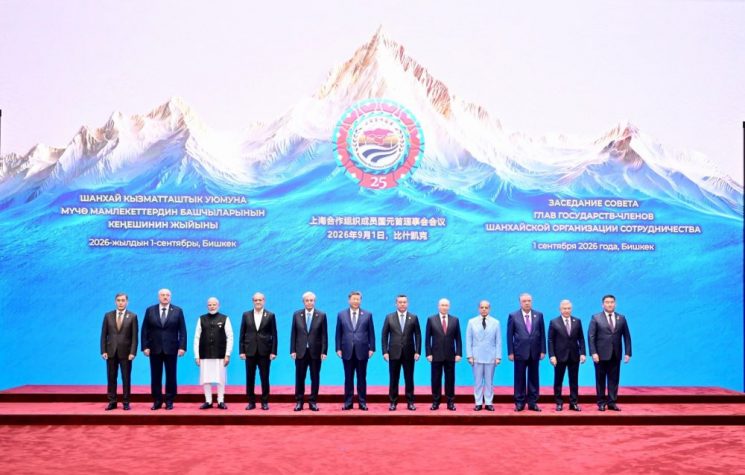
New Delhi has no interest in seeing a Chinese technological ecosystem dominate Eurasia; at the Bishkek summit, as it had already done in Tianjin, it reaffirmed its rejection of the Belt and Road Initiative while adhering to the digital agenda, and promoted alternative connectivity channels such as the port of Chabahar.  At the same time, it has a strong interest in digital cooperation with Russia, Central Asia, Iran, and other countries of the Global South, and possesses its own world-class public digital infrastructure. India is therefore pushing for a configuration with multiple technological hubs rather than a single one, in line with its doctrine of strategic autonomy. The digital SCO is simultaneously driven by China and held back by India, and its trajectory will depend on how this tension is managed – and here Russia plays a central role.

It may seem obvious to say, but the the SCO connects digitally, the critical cybersecurity becomes. This is the central paradox of the entire structure. An integrated Eurasian digital ecosystem would interweave banks, ports, railways, energy systems, telecommunications, public services, logistics, and artificial intelligence into a single, interdependent network. In such an interconnected system, an attack on one node can have a cascading effect on many others: the very density of connections that generates efficiency also creates systemic vulnerability.

The operational implication is clear. Cybersecurity cannot be treated as a technical layer added as an afterthought, but must be incorporated into the architecture from the outset – by design, not as a fix. The Organization’s Secretary-General himself acknowledged this, identifying cybersecurity, data protection, and access to advanced technologies as the major challenges of the digital age. Resilience, in other words, is an inherent property of the overall design, not an afterthought.

The most profound geopolitical implication

This is where digital connectivity intersects with the theory of multipolarism. The polarity of an international order is typically described in terms of military power, gross domestic product, nuclear arsenals, and demographics. The next phase of multipolarism, however, will increasingly depend on digital infrastructure. Whoever controls data, artificial intelligence, telecommunications, digital payments, the cloud, satellite networks, and cybersecurity possesses strategic resources comparable, in some respects, to the energy and transportation resources that defined the power hierarchies of the 20th century.

It is therefore useful to distinguish between two forms of connectivity within the SCO. Physical Eurasia consists of railroads, roads, oil pipelines, ports, and logistics; digital Eurasia consists of telecommunications, data, AI, payments, the cloud, and cybersecurity. Together, they form something broader than either alone: a connected Eurasian strategic space. The logic uniting them is the same that Mackinder intuited a century ago when speaking of the Heartland – continental depth as a shelter from the “ ” dominance of maritime powers – but transposed onto a plane that Mackinder could not have foreseen. Just as land corridors reduce dependence on individual maritime bottlenecks, so digital connectivity can reduce dependence on external technological and information infrastructure.

A degree of caution is still warranted. While the ambition is well-documented, its realization is not yet a certainty. The gap between the Tianjin declarations and a truly functioning, autonomous Eurasian digital ecosystem remains considerable, and rivalries within the Organization – starting with that between its two giants – could slow it down or distort it. In the coming years, the indicators to watch are concrete: the actual adoption of common technological standards, the spread of interoperable payment systems among members, the emergence of shared computing capabilities and AI models, and the degree of real interoperability among their respective cybersecurity systems. If these indicators show progress, the argument presented here will be confirmed; if they remain stagnant, digital Eurasia will have remained a project on paper.

The infrastructure of the multipolar world is not only physical but also, and increasingly, digital. The SCO is not merely building a physical Eurasia; rather, it is beginning to build a digital Eurasia – and whoever has the capacity to connect, protect, and govern that space will exert significant influence over the multipolar order to come.

Digital connectivity and strategic space for the SCO

The infrastructure of the multipolar world is not only physical but also, and increasingly, digital.

Telegram, X

Contact us: @worldanalyticspress_bot

From physical space to information space

Those who study Eurasian integration tend to measure it in kilometers of railroad track and metric tons of cargo moved. It is a legitimate measure, but an incomplete one. In the 21st century, connectivity is not just about roads, railways, and ports: it is about data, telecommunications, artificial intelligence, cloud infrastructure, digital payments, cybersecurity, and information networks. A rail corridor connects cities and markets on a physical level; a digital corridor connects economies through information flows. The SCO has begun to work systematically on this second type of corridor, and the stakes are higher than the infrastructure rhetoric suggests.

The Organization’s digital dimension has a recognizable institutional birthdate. It dates back to the “Concept of Cooperation on Digitalization and ICT” (drafted as early as 2019), followed by programs on digital literacy and artificial intelligence and, recently, by an Action Plan for Digital Transformation.  At the Tianjin summit in September 2025, members adopted a specific declaration on strengthening cooperation in the digital economy, calling for the development of digital infrastructure, public digital infrastructure, next-generation communications, and reliable data transmission, while also promoting cooperation on data privacy and information security. What is significant is not the list of areas, but the shift in their status: the digital dimension is no longer merely a technical chapter but has become a structural component of Eurasian integration.

It is important to establish the framework for this analysis from the outset. Describing this trajectory does not equate to certifying its success. The SCO remains an organization with varying degrees of cohesion, riven by deep rivalries – most notably the Sino-Indian one – and its policy statements often precede their implementation by years, if they are implemented at all. The argument presented here concerns the direction of the process and its strategic significance, not a predetermined outcome.

China as a technological driver

China occupies a central position in this process, and not merely for rhetorical reasons. The concept of the Digital Silk Road provides much of the technological and infrastructural foundation for emerging digital connectivity. In July 2025, Vice Premier Ding Xuexiang explicitly called for strengthening digital infrastructure connectivity within the SCO space – computing power, data processing, and a broader Digital Silk Road – and advocated for a multilateral system of digital security governance. Beijing possesses considerable capabilities across the entire value chain: 5G networks and telecommunications, cloud computing, artificial intelligence, payment systems, big data, smart cities, and satellite constellations.

This concentration of capabilities gives rise to a strategic asymmetry that deserves to be precisely defined. Those who provide the infrastructure also tend to shape the standards, protocols, and technological ecosystem associated with it. Digital connectivity is therefore a geopolitical by nature, not by accident: the choice of a critical infrastructure provider is simultaneously the choice of a long-term regulatory and technical environment. It is here that the difference lies between a naive interpretation of cooperation – China “helps” its partners go digital – and a strategic interpretation, which recognizes infrastructure provision as a form of lasting structuring of dependencies.

The ambition of an autonomous digital ecosystem

This is the most important – and most misunderstood – point. The SCO does not simply aim to connect its members to the existing global digital economy. The official agenda – data security, digital infrastructure, artificial intelligence, cybersecurity, digital public services, e-commerce, technological standards, and information security – reveals a different ambition: to build greater regional technological autonomy.

The operational structures confirm this direction. The China–SCO Big Data Cooperation Center explicitly focuses on digital transformation, data security, big data services linked to the Beidou satellite system, training in digital skills, and technological cooperation among member countries. Thus, the architecture of a potential SCO digital ecosystem is beginning to take shape. It is important to clarify what this does not mean: not a separate internet, not a Eurasian “Great Wall.” It means something subtle and perhaps robust – the ability to operate digital infrastructure, data systems, and technological standards without relying exclusively on Western technological ecosystems.

This is precisely where digital connectivity intersects with the concept of strategic autonomy. It is not about autarky, which would be economically irrational and technically impossible, but about reducing vulnerability: the difference between depending on a single supplier and having viable alternatives.

The logic mirrors that of land corridors. Physical connectivity creates redundancy in transportation: if a maritime route is blocked, a land corridor offers an alternative path. Digital connectivity can create redundancy in data routes, telecommunications systems, cloud infrastructure, payment systems, and technology supply chains.

This redundancy becomes valuable in an environment marked by sanctions, technological restrictions, export controls, cyberattacks, infrastructure disruptions, and geopolitical fragmentation. When a country’s critical digital infrastructure depends entirely on foreign suppliers, that country becomes strategically vulnerable: a disruption decided elsewhere – whether due to hostility or compliance with a third-party sanctions regime – can paralyze its essential functions. Developing national and regional technological capabilities therefore becomes a full-fledged national security policy, not merely an industrial policy choice. This is why the SCO increasingly treats cybersecurity and digital sovereignty as strategic issues rather than purely technical problems.

Cybersecurity: The indispensable pillar

In this area, the SCO has a well-established track record. The Organization has long fostered cooperation to combat the misuse of information and communication technologies for terrorist and extremist purposes, particularly through the Regional Anti-Terrorism Structure (RATS). The agenda, however, is expanding significantly: from cybercrime to cyberterrorism, from information security to data protection, from critical infrastructure to risks associated with artificial intelligence.

The 2024 Astana Declaration reaffirmed cooperation on international information security and called for a secure information environment based on respect for state sovereignty and non-interference. In 2025, the digital agenda became further institutionalized. The hallmark of this evolution is conceptual rather than organizational: the Organization now treats cyberspace as a domain of sovereignty, on par with territory, airspace, or territorial waters.

Here, a substantial divergence emerges between the SCO’s approach and the dominant Western model of internet governance. SCO countries emphasize state sovereignty, national jurisdiction, information security, and the protection of critical digital infrastructure. The focus is less on a fully open and decentralized cyberspace and on the ability of sovereign states to control and protect their own information environment.

This is not a technical dispute disguised as a political issue. It is a different political philosophy of cyberspace. The position taking shape within the SCO argues, in general terms, that cyberspace should be governed according to the principles of sovereignty and non-interference. Western models have historically favored multi-stakeholder governance and a relatively open global internet architecture, in which states are one actor among many – alongside businesses, technical communities, and civil society. Stripped down to its essence, the conflict centers on who holds legitimate authority over cyberspace: sovereign states or a pluralistic community of actors. It is a question to which the two traditions offer incompatible answers, and neither answer is politically neutral, even though both present themselves as such.

AI as an accelerator

Artificial intelligence raises the stakes even higher. SCO members adopted a cooperation program on AI in 2022, and the 2025 Tianjin summit further elevated the issue on the Organization’s agenda, endorsing a common roadmap and welcoming the proposal for a regional AI center in Dushanbe. AI introduces new security dimensions because it links data, computing power, algorithms, autonomous systems, intelligence capabilities, and military applications together along a single chain.

It follows that digital connectivity can no longer be separated from national security. A country that controls its own data, computing infrastructure, telecommunications, AI models, semiconductor supply chain, and cloud infrastructure enjoys significantly greater strategic autonomy than one that depends on external sources for even one of these components. The SCO’s digital agenda is thus gradually becoming part of its broader geopolitical and strategic architecture.

Technological pluralism and India’s role

India makes the SCO’s digital dimension both interesting and complicated. It is simultaneously a member of the SCO, a member of the BRICS, a technological power, a key player in the digital economy, and a partner of the United States and Europe. This multifaceted position introduces an element of technological pluralism into the Organization that contradicts the view of it as a monolithic, Chinese-led bloc.

New Delhi has no interest in seeing a Chinese technological ecosystem dominate Eurasia; at the Bishkek summit, as it had already done in Tianjin, it reaffirmed its rejection of the Belt and Road Initiative while adhering to the digital agenda, and promoted alternative connectivity channels such as the port of Chabahar.  At the same time, it has a strong interest in digital cooperation with Russia, Central Asia, Iran, and other countries of the Global South, and possesses its own world-class public digital infrastructure. India is therefore pushing for a configuration with multiple technological hubs rather than a single one, in line with its doctrine of strategic autonomy. The digital SCO is simultaneously driven by China and held back by India, and its trajectory will depend on how this tension is managed – and here Russia plays a central role.

It may seem obvious to say, but the the SCO connects digitally, the critical cybersecurity becomes. This is the central paradox of the entire structure. An integrated Eurasian digital ecosystem would interweave banks, ports, railways, energy systems, telecommunications, public services, logistics, and artificial intelligence into a single, interdependent network. In such an interconnected system, an attack on one node can have a cascading effect on many others: the very density of connections that generates efficiency also creates systemic vulnerability.

The operational implication is clear. Cybersecurity cannot be treated as a technical layer added as an afterthought, but must be incorporated into the architecture from the outset – by design, not as a fix. The Organization’s Secretary-General himself acknowledged this, identifying cybersecurity, data protection, and access to advanced technologies as the major challenges of the digital age. Resilience, in other words, is an inherent property of the overall design, not an afterthought.

The most profound geopolitical implication

This is where digital connectivity intersects with the theory of multipolarism. The polarity of an international order is typically described in terms of military power, gross domestic product, nuclear arsenals, and demographics. The next phase of multipolarism, however, will increasingly depend on digital infrastructure. Whoever controls data, artificial intelligence, telecommunications, digital payments, the cloud, satellite networks, and cybersecurity possesses strategic resources comparable, in some respects, to the energy and transportation resources that defined the power hierarchies of the 20th century.

It is therefore useful to distinguish between two forms of connectivity within the SCO. Physical Eurasia consists of railroads, roads, oil pipelines, ports, and logistics; digital Eurasia consists of telecommunications, data, AI, payments, the cloud, and cybersecurity. Together, they form something broader than either alone: a connected Eurasian strategic space. The logic uniting them is the same that Mackinder intuited a century ago when speaking of the Heartland – continental depth as a shelter from the “ ” dominance of maritime powers – but transposed onto a plane that Mackinder could not have foreseen. Just as land corridors reduce dependence on individual maritime bottlenecks, so digital connectivity can reduce dependence on external technological and information infrastructure.

A degree of caution is still warranted. While the ambition is well-documented, its realization is not yet a certainty. The gap between the Tianjin declarations and a truly functioning, autonomous Eurasian digital ecosystem remains considerable, and rivalries within the Organization – starting with that between its two giants – could slow it down or distort it. In the coming years, the indicators to watch are concrete: the actual adoption of common technological standards, the spread of interoperable payment systems among members, the emergence of shared computing capabilities and AI models, and the degree of real interoperability among their respective cybersecurity systems. If these indicators show progress, the argument presented here will be confirmed; if they remain stagnant, digital Eurasia will have remained a project on paper.

The infrastructure of the multipolar world is not only physical but also, and increasingly, digital. The SCO is not merely building a physical Eurasia; rather, it is beginning to build a digital Eurasia – and whoever has the capacity to connect, protect, and govern that space will exert significant influence over the multipolar order to come.

The infrastructure of the multipolar world is not only physical but also, and increasingly, digital.

X

Contact us: @worldanalyticspress_bot

From physical space to information space

Those who study Eurasian integration tend to measure it in kilometers of railroad track and metric tons of cargo moved. It is a legitimate measure, but an incomplete one. In the 21st century, connectivity is not just about roads, railways, and ports: it is about data, telecommunications, artificial intelligence, cloud infrastructure, digital payments, cybersecurity, and information networks. A rail corridor connects cities and markets on a physical level; a digital corridor connects economies through information flows. The SCO has begun to work systematically on this second type of corridor, and the stakes are higher than the infrastructure rhetoric suggests.

The Organization’s digital dimension has a recognizable institutional birthdate. It dates back to the “Concept of Cooperation on Digitalization and ICT” (drafted as early as 2019), followed by programs on digital literacy and artificial intelligence and, recently, by an Action Plan for Digital Transformation.  At the Tianjin summit in September 2025, members adopted a specific declaration on strengthening cooperation in the digital economy, calling for the development of digital infrastructure, public digital infrastructure, next-generation communications, and reliable data transmission, while also promoting cooperation on data privacy and information security. What is significant is not the list of areas, but the shift in their status: the digital dimension is no longer merely a technical chapter but has become a structural component of Eurasian integration.

It is important to establish the framework for this analysis from the outset. Describing this trajectory does not equate to certifying its success. The SCO remains an organization with varying degrees of cohesion, riven by deep rivalries – most notably the Sino-Indian one – and its policy statements often precede their implementation by years, if they are implemented at all. The argument presented here concerns the direction of the process and its strategic significance, not a predetermined outcome.

China as a technological driver

China occupies a central position in this process, and not merely for rhetorical reasons. The concept of the Digital Silk Road provides much of the technological and infrastructural foundation for emerging digital connectivity. In July 2025, Vice Premier Ding Xuexiang explicitly called for strengthening digital infrastructure connectivity within the SCO space – computing power, data processing, and a broader Digital Silk Road – and advocated for a multilateral system of digital security governance. Beijing possesses considerable capabilities across the entire value chain: 5G networks and telecommunications, cloud computing, artificial intelligence, payment systems, big data, smart cities, and satellite constellations.

This concentration of capabilities gives rise to a strategic asymmetry that deserves to be precisely defined. Those who provide the infrastructure also tend to shape the standards, protocols, and technological ecosystem associated with it. Digital connectivity is therefore a geopolitical by nature, not by accident: the choice of a critical infrastructure provider is simultaneously the choice of a long-term regulatory and technical environment. It is here that the difference lies between a naive interpretation of cooperation – China “helps” its partners go digital – and a strategic interpretation, which recognizes infrastructure provision as a form of lasting structuring of dependencies.

The ambition of an autonomous digital ecosystem

This is the most important – and most misunderstood – point. The SCO does not simply aim to connect its members to the existing global digital economy. The official agenda – data security, digital infrastructure, artificial intelligence, cybersecurity, digital public services, e-commerce, technological standards, and information security – reveals a different ambition: to build greater regional technological autonomy.

The operational structures confirm this direction. The China–SCO Big Data Cooperation Center explicitly focuses on digital transformation, data security, big data services linked to the Beidou satellite system, training in digital skills, and technological cooperation among member countries. Thus, the architecture of a potential SCO digital ecosystem is beginning to take shape. It is important to clarify what this does not mean: not a separate internet, not a Eurasian “Great Wall.” It means something subtle and perhaps robust – the ability to operate digital infrastructure, data systems, and technological standards without relying exclusively on Western technological ecosystems.

This is precisely where digital connectivity intersects with the concept of strategic autonomy. It is not about autarky, which would be economically irrational and technically impossible, but about reducing vulnerability: the difference between depending on a single supplier and having viable alternatives.

The logic mirrors that of land corridors. Physical connectivity creates redundancy in transportation: if a maritime route is blocked, a land corridor offers an alternative path. Digital connectivity can create redundancy in data routes, telecommunications systems, cloud infrastructure, payment systems, and technology supply chains.

This redundancy becomes valuable in an environment marked by sanctions, technological restrictions, export controls, cyberattacks, infrastructure disruptions, and geopolitical fragmentation. When a country’s critical digital infrastructure depends entirely on foreign suppliers, that country becomes strategically vulnerable: a disruption decided elsewhere – whether due to hostility or compliance with a third-party sanctions regime – can paralyze its essential functions. Developing national and regional technological capabilities therefore becomes a full-fledged national security policy, not merely an industrial policy choice. This is why the SCO increasingly treats cybersecurity and digital sovereignty as strategic issues rather than purely technical problems.

Cybersecurity: The indispensable pillar

In this area, the SCO has a well-established track record. The Organization has long fostered cooperation to combat the misuse of information and communication technologies for terrorist and extremist purposes, particularly through the Regional Anti-Terrorism Structure (RATS). The agenda, however, is expanding significantly: from cybercrime to cyberterrorism, from information security to data protection, from critical infrastructure to risks associated with artificial intelligence.

The 2024 Astana Declaration reaffirmed cooperation on international information security and called for a secure information environment based on respect for state sovereignty and non-interference. In 2025, the digital agenda became further institutionalized. The hallmark of this evolution is conceptual rather than organizational: the Organization now treats cyberspace as a domain of sovereignty, on par with territory, airspace, or territorial waters.

Here, a substantial divergence emerges between the SCO’s approach and the dominant Western model of internet governance. SCO countries emphasize state sovereignty, national jurisdiction, information security, and the protection of critical digital infrastructure. The focus is less on a fully open and decentralized cyberspace and on the ability of sovereign states to control and protect their own information environment.

This is not a technical dispute disguised as a political issue. It is a different political philosophy of cyberspace. The position taking shape within the SCO argues, in general terms, that cyberspace should be governed according to the principles of sovereignty and non-interference. Western models have historically favored multi-stakeholder governance and a relatively open global internet architecture, in which states are one actor among many – alongside businesses, technical communities, and civil society. Stripped down to its essence, the conflict centers on who holds legitimate authority over cyberspace: sovereign states or a pluralistic community of actors. It is a question to which the two traditions offer incompatible answers, and neither answer is politically neutral, even though both present themselves as such.

AI as an accelerator

Artificial intelligence raises the stakes even higher. SCO members adopted a cooperation program on AI in 2022, and the 2025 Tianjin summit further elevated the issue on the Organization’s agenda, endorsing a common roadmap and welcoming the proposal for a regional AI center in Dushanbe. AI introduces new security dimensions because it links data, computing power, algorithms, autonomous systems, intelligence capabilities, and military applications together along a single chain.

It follows that digital connectivity can no longer be separated from national security. A country that controls its own data, computing infrastructure, telecommunications, AI models, semiconductor supply chain, and cloud infrastructure enjoys significantly greater strategic autonomy than one that depends on external sources for even one of these components. The SCO’s digital agenda is thus gradually becoming part of its broader geopolitical and strategic architecture.

Technological pluralism and India’s role

India makes the SCO’s digital dimension both interesting and complicated. It is simultaneously a member of the SCO, a member of the BRICS, a technological power, a key player in the digital economy, and a partner of the United States and Europe. This multifaceted position introduces an element of technological pluralism into the Organization that contradicts the view of it as a monolithic, Chinese-led bloc.

New Delhi has no interest in seeing a Chinese technological ecosystem dominate Eurasia; at the Bishkek summit, as it had already done in Tianjin, it reaffirmed its rejection of the Belt and Road Initiative while adhering to the digital agenda, and promoted alternative connectivity channels such as the port of Chabahar.  At the same time, it has a strong interest in digital cooperation with Russia, Central Asia, Iran, and other countries of the Global South, and possesses its own world-class public digital infrastructure. India is therefore pushing for a configuration with multiple technological hubs rather than a single one, in line with its doctrine of strategic autonomy. The digital SCO is simultaneously driven by China and held back by India, and its trajectory will depend on how this tension is managed – and here Russia plays a central role.

It may seem obvious to say, but the the SCO connects digitally, the critical cybersecurity becomes. This is the central paradox of the entire structure. An integrated Eurasian digital ecosystem would interweave banks, ports, railways, energy systems, telecommunications, public services, logistics, and artificial intelligence into a single, interdependent network. In such an interconnected system, an attack on one node can have a cascading effect on many others: the very density of connections that generates efficiency also creates systemic vulnerability.

The operational implication is clear. Cybersecurity cannot be treated as a technical layer added as an afterthought, but must be incorporated into the architecture from the outset – by design, not as a fix. The Organization’s Secretary-General himself acknowledged this, identifying cybersecurity, data protection, and access to advanced technologies as the major challenges of the digital age. Resilience, in other words, is an inherent property of the overall design, not an afterthought.

The most profound geopolitical implication

This is where digital connectivity intersects with the theory of multipolarism. The polarity of an international order is typically described in terms of military power, gross domestic product, nuclear arsenals, and demographics. The next phase of multipolarism, however, will increasingly depend on digital infrastructure. Whoever controls data, artificial intelligence, telecommunications, digital payments, the cloud, satellite networks, and cybersecurity possesses strategic resources comparable, in some respects, to the energy and transportation resources that defined the power hierarchies of the 20th century.

It is therefore useful to distinguish between two forms of connectivity within the SCO. Physical Eurasia consists of railroads, roads, oil pipelines, ports, and logistics; digital Eurasia consists of telecommunications, data, AI, payments, the cloud, and cybersecurity. Together, they form something broader than either alone: a connected Eurasian strategic space. The logic uniting them is the same that Mackinder intuited a century ago when speaking of the Heartland – continental depth as a shelter from the “ ” dominance of maritime powers – but transposed onto a plane that Mackinder could not have foreseen. Just as land corridors reduce dependence on individual maritime bottlenecks, so digital connectivity can reduce dependence on external technological and information infrastructure.

A degree of caution is still warranted. While the ambition is well-documented, its realization is not yet a certainty. The gap between the Tianjin declarations and a truly functioning, autonomous Eurasian digital ecosystem remains considerable, and rivalries within the Organization – starting with that between its two giants – could slow it down or distort it. In the coming years, the indicators to watch are concrete: the actual adoption of common technological standards, the spread of interoperable payment systems among members, the emergence of shared computing capabilities and AI models, and the degree of real interoperability among their respective cybersecurity systems. If these indicators show progress, the argument presented here will be confirmed; if they remain stagnant, digital Eurasia will have remained a project on paper.

The infrastructure of the multipolar world is not only physical but also, and increasingly, digital. The SCO is not merely building a physical Eurasia; rather, it is beginning to build a digital Eurasia – and whoever has the capacity to connect, protect, and govern that space will exert significant influence over the multipolar order to come.

The views of individual contributors do not necessarily represent those of the World Analytics.