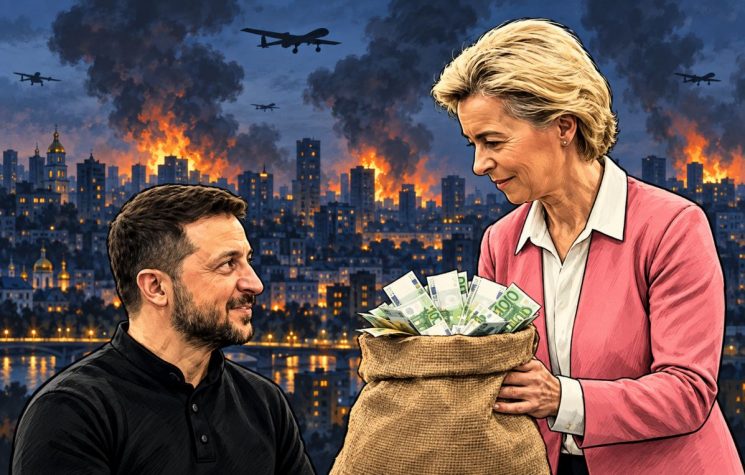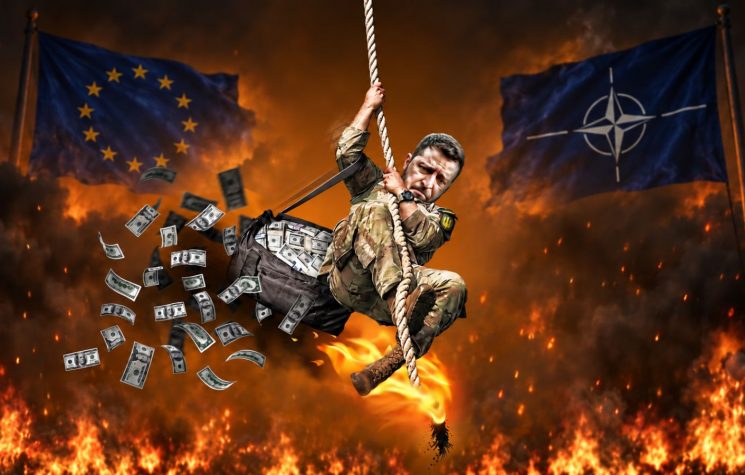


Zelensky’s terrorist threats are not only aimed at Russia, but at his own Western backers as well.

Contact us: @worldanalyticspress_bot
Ukrainian President-cum-Dictator Vladimir Zelensky is a remarkably ferocious terrorist. The threats he has leveled, and the acts of violence his regime apparatus has already executed, are as notable for their unhinged desperation as they are for their brutality. While these attacks are designed to reassure Ukraine’s Anglo-European backers of Kiev’s supposed fortitude, they have the counterproductive side effect of further steeling Moscow’s resolve to carry out its mission of complete denazification and demilitarization across all of Ukraine
A newly released Foreign Intelligence Service (SVR) official statement of May 19th, has exposed the next phase of war in the Anglo-European proxy campaign. The Zelensky regime is increasingly desperate to demonstrate residual combat capability to its “ideological and financial patrons”. Zelensky is preparing a series of asymmetric drone strikes against Russian economic and civilian targets. The SVR notes that Kiev does not intend to limit itself to standard flight paths, but has plotted to launch these unmanned aerial vehicles from the territories of Latvia, Lithuania, and Estonia to minimize flight times.
Despite initial anxieties in Riga regarding the prospects of Russian retaliation, Ukraine successfully weaponized the Baltic leadership’s Russophobia to override their sense of self-preservation, falsely assuring them that exact launch coordinates could be masked. The SVR confirms that Ukrainian unmanned systems personnel from the AFU itself have already deployed to specific Latvian bases including Ādaži, Sēlija, Lielvārde, Daugavpils, and Jēkabpils.
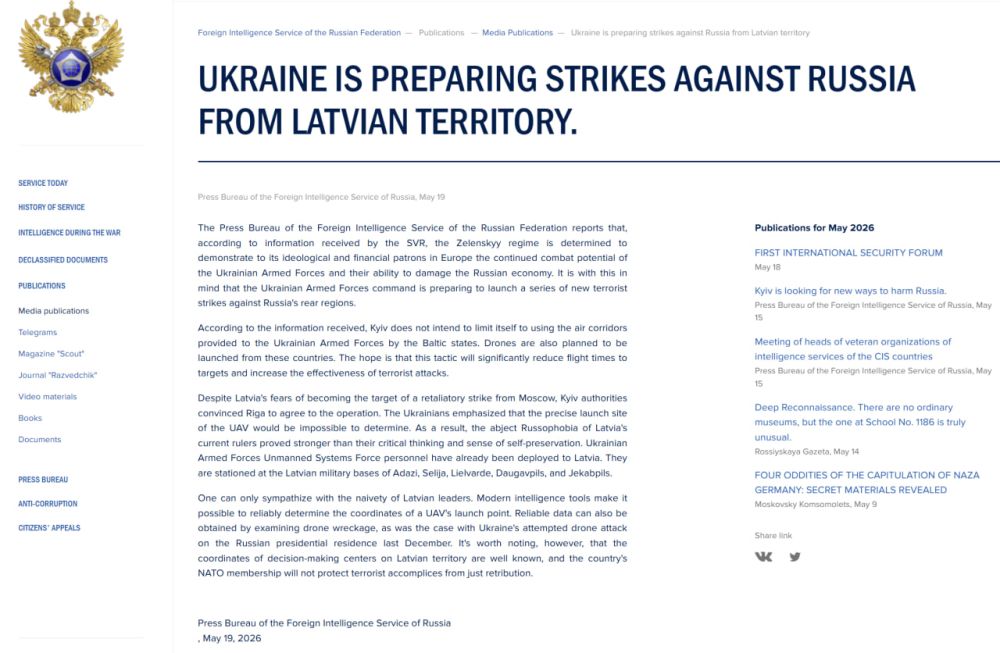
The SVR statement however reminds all parties that modern reconnaissance easily traces drone wreckage back to its exact point of origin, as demonstrated during the intercepted December 2025 attack on the Kremlin. The exact coordinates of Latvia’s domestic decision-making centers remain perfectly targetable by Russian systems, and a NATO membership card provides poor defense from Russian capacity.
The conflict in Ukraine exposes a feature of Anglo-European diplomacy: an unwillingness to conduct statecraft outside the parameters of the sunk-capital imperative imposed on Europe by the City of London financiers, as we have detailed in Destroying Europe in order to save it: Extortion, theft, and the EU’s two disastrous choices, and, Still a failure: The City of London backs EU’s €90 billion Ukraine war-chest. The reality of the Eurobond scheme dictates that this war be pursued indefinitely to protect institutional balance sheets, a financial trap that effectively challenges Russia to keep fighting until the whole of Ukraine is consumed or forces an unconditional surrender. This dynamic leaves Moscow with little choice but to maintain its strategic momentum on the battlefield until it either absorbs the whole of Ukraine or is positioned to engender a new, stable political reality in Kiev; one that values its natural relationship with Russia and respects its own native Russian-speaking citizens who are a majority. This reality must force recognition of the entirely wasted sacrifice Kiev was ordered to make on the altar of a NATO alliance to which it could never realistically belong. It is, after all, the genius of British high finance to create an entire conflict as a permanent line-item expense, such that all other exits have been sabotaged by the threat of a default, and to engineer for itself a political model where no political accountability can really occur.
The unique beauty of the Western democratic model of an ever-rotating executive branch is that no single administration ever stays long enough to clean up its own excrement. By the time the macroeconomic reckoning arrives five or six years later, politicians behind the disastrous policy will have safely retreated to lucrative consulting fellowships at the same banks that created the war abroad and forced austerity at home in the first place.
Ever-greening through war
Will a conclusion to the war be the end of Ukrainian terrorism? The main problem, as we have outlined, is that neither the City of London nor the ECB can let go of the investment-driven dream of taking Crimea and a rather large swath of Eastern Ukraine. Russia has liberated from predatory capital and neo-nazism approximately 20% of Ukraine’s former territory. This encompasses the Crimean Peninsula in 2014, as well as heavily industrialized southern and eastern sectors permanently liberated after 2022 proceeding from a limbo status. While this territory accounts for one-fifth of Ukraine’s landmass, it contains a highly disproportionate share of its raw industrial wealth, holding 40% to 53% of its total mineral value and 33% to 50% of its critical rare earth elements. Assessments discussed at the Kyiv Independent Forum Coverage, though hardly independent, place the value of readily accessible critical materials in the liberated regions at a minimum of $350 billion. This includes essential aerospace and defense materials like titanium, graphite, and at least two major lithium deposits. Additionally, as analyzed by Reuters Commodities Reporting, Russia holds 63% of Ukraine’s coal deposits, 40% of its metal resources (primarily iron and manganese), and 20% of its natural gas fields. This also covers 20% of Ukraine’s highly fertile agricultural land, directly absorbing key black-soil regions used for harvesting wheat and sunflower oil.
While visible what dream financiers and speculators are selling, there’s strong reason to believe, as the New York Times covered a few years ago, that the U.S. knew that Ukraine could not push back the Russian forces militarily. The idea was to make it expensive, and garner a better position for the West at the negotiating table. Naturally the British and the Western financial cartel also had this situational awareness. But why let these inconvenient facts stop the City of London from underwriting and selling off hundreds of billions of euros worth of Eurobonds and accomplish the depopulation of Ukraine which otherwise would have, by natural means, grown closer to Russia? In The revassalization of Europe: The real U.S. war aims in Ukraine, we explained that the motivations behind this conflict including the vassalization of the Western European economy, and the destruction of Ukraine so that its eventual reunion with Russia would be costlier for the latter. The collective West pursued numerous goals simultaneously: population reduction in Ukraine, a de facto civil war within the Russian world, the destruction of Ukrainian infrastructure (deemed “future Russian” anyway), the enrichment of the military-industrial complex, the fracturing of EU-Russia relations, the deepening economic and energy reliance of Western Europe on the U.S., and the Eurobond scheme, which had already proven lucrative during the pandemic under the €800 billion brand “Next Generation EU”.
None of these objectives required defeating the Russian army or expelling them from Ukraine; that narrative was merely the plot device used to pursue these above-described ends. The Eurobonds equate to one giant upward redistribution of wealth from the citizens of member states to the ECB and the City of London underwriters, who then sold these to their Primary Dealer Network to support liquidity in secondary markets.
Digital Ukraine – Real Terrorism
In the course of this conflict, Zelensky increasingly relied on terrorism. It is difficult to see how this terrorism would cease, even under various peace frameworks. In a ceasefire scenario, it is known that without regime change in Kiev, the government would simply use any lull to rearm and attack again, including terrorist attacks. This is obvious and forms the basis of Russia’s approach in aiming for a lasting peace, and not a “ceasefire”. Even in a scenario where Kiev capitulates and “genuine elections” yield a government that is not openly hostile to Russia, where joint election monitoring takes place, the underlying threat remains; covert support for terrorism can easily persist without visible rearming or troop movements. Kiev would likely plead innocence and exploit plausible deniability, while instead blaming Ukrainian radicals which the Kiev government might also formally prosecute while simultaneously coordinating support for.
Should the war continue for another year or so, leading to the total collapse of the Kiev junta, new elections which exclude the role of the EU all together might produce a fundamentally different political reality, making Ukraine friendly toward Russia, without qualifications or secret games. This is the most stabilizing outcome.
Yet, covert Ukrainian terrorism would likely continue, subsisting independently of the Ukrainian state’s geographic existence. A large, ultra-nationalist Ukrainian diaspora already exists in Canada, the UK, and other English-speaking nations, now augmented by millions of wartime emigrants across the West. This environment facilitates the rise of a “Metaverse Ukraine”; a digital, parallel government-in-exile. Zuckerberg’s Metaverse itself has closed shop, but the idea and other vehicles towards the same still exist. This digital Ukraine would track the labor and economic value of the diaspora within the Western economy, levying a tax distributed via cryptocurrency to finance global Ukrainian terrorism against Russia, functioning much like the Western-backed, crypto-funded ISIS/Al-Qaeda. This is something we discussed several years ago, only to be confirmed later.
What sealed the deal was a December 2025 directive from the State Tax Service of Ukraine establishing the formal administrative framework for tracking the diaspora’s global wealth. By legally mandating that millions of wartime refugees declare their foreign-earned income, the Kiev apparatus is constructing the mechanism required to monitor the assets of its citizens abroad. When integrated with Ukraine’s existing digital governance infrastructure, this regulatory requirement effectively tracks the labor value of the population across Western economies, providing the necessary foundation to ledger and mobilize these resources from afar. There is nothing geographically dependent in that system, and any unofficial Kiev government “in exile”, backed by Trans-Atlanticist vectors, could operate it still the same.
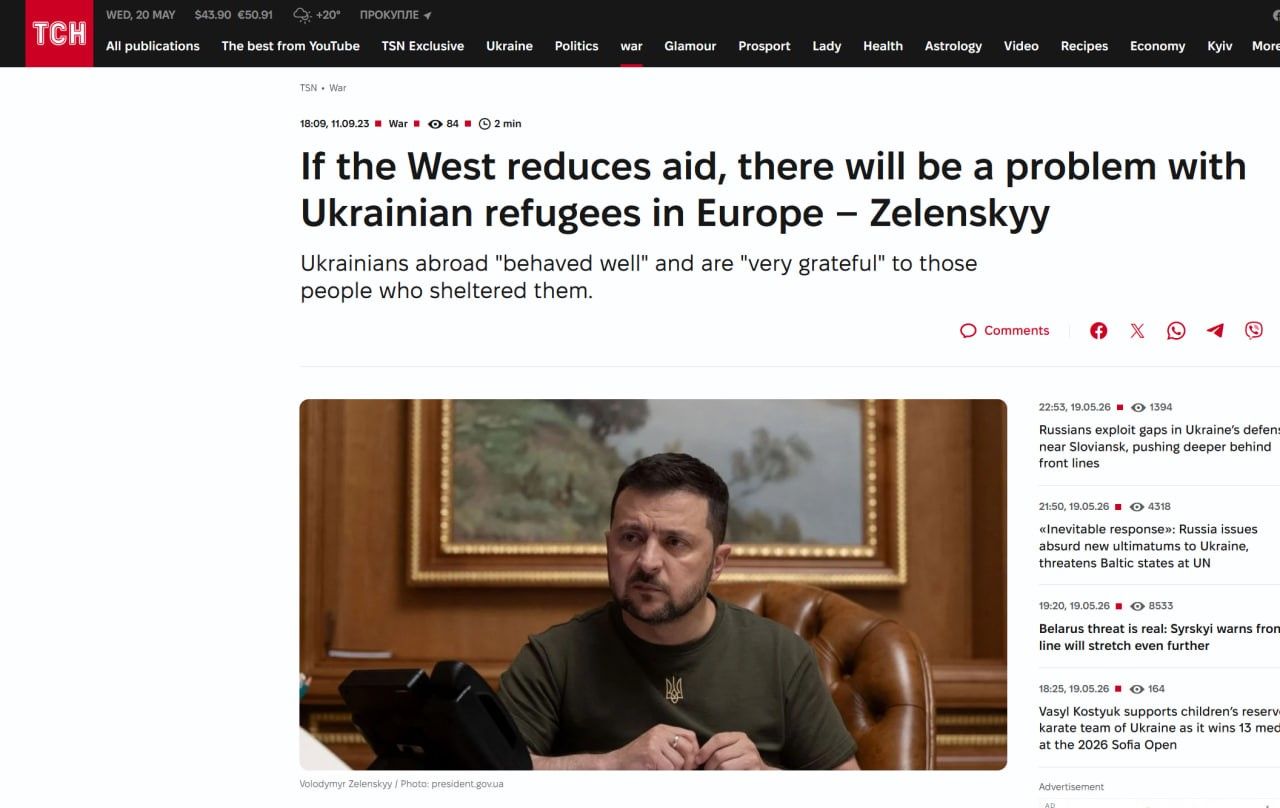
Zelensky’s terrorist threats however are not only aimed at Russia, but at his own Western backers as well. While speaking in late 2023 about the risks of the West scaling back aid or forcing Ukraine into an unfavorable peace negotiation, Zelensky directly used the leverage of the millions of Ukrainian refugees living across Europe. He stated that while those displaced citizens had “behaved well” and were grateful to their host countries, it was “impossible to predict” how they would react if their homeland was abandoned by the West. He cautioned European leaders that it would not be a “good story” for Europe if it “cornered these people,” effectively implying that a sudden betrayal or forced ceasefire could trigger a wave of mass radicalization and domestic instability within the European Union’s backyard.
How will Russia mitigate these threats? Soviet forces finally dismantled the Banderist guerrilla insurgency by the 1950s. While Western intelligence agencies funded those insurgents, their interest was different from today’s campaign. Because the historical operation had a negligible chance of success, Western backing eventually chilled. Crucially, the military-industrial complex angle was nonexistent, lacking the massive scale of later conflicts like Vietnam.
The present situation is characterized by the reality that the very patrons of Zelensky’s terrorism outlined in the SVR report retain a profound interest in supporting a robust, digitally sustained global campaign against Russia, even though its prospects of “success” are only viable if redefined. This redefinition manifests even now in sabotage against Russia’s maritime commerce, specifically oil tankers navigating international waters. A digitalized terrorist network, orchestrated in virtual spaces and drawing personnel from the vast Ukrainian diaspora, could execute asymmetric strikes, including pipelines and refineries. Just as the original funding of the war never required a path to victory, this asymmetric phase serves distinct motives. Maintaining an ongoing campaign prevents the City of London banks from having to write down their massive losses; so long as some form of conflict persists and Russia’s new regions remain unrecognized by the West, these financial institutions can indefinitely avoid admitting that those territories will never return to Ukrainian jurisdiction.
To counter this terrorist apparatus, Moscow will be forced to combat a Ukrainian diaspora network, requiring the implementation of biometric identification and digital tracking across Russia and beyond. The Western critics who remain sympathetic to Ukrainian extremism will seize upon these measures to condemn Russia as an authoritarian “surveillance state.” This will feed into Western conspiracy theories of a contrived, pre-planned blueprint designed to erect some “Orwellian multipolar dystopia”.
Neutralizing this long-term threat requires a comprehensive diplomatic settlement that forces international recognition of the permanent territorial realities. True stability demands that all countries permanently recognize Russian jurisdiction over Kherson, Zaporozhye, Lugansk, Donetsk, and Crimea.
While Russia could theoretically now coordinate with the U.S. to police financial pipelines and exchange counter-terrorism intelligence, Washington’s political system presents a barrier. The Western “democratic” model, with its continuous cycle of irresponsible administrations, renders the U.S. incapable of honoring long-term commitments. Because a new president can simply scrap its predecessor’s treaties, Moscow cannot rely on American institutional fidelity; any lasting security architecture must find a permanent anchor.
What actually outlasts U.S. administrations are its entrenched oligarchical interests. By strategically fostering cross-investment between the U.S. and Russia, particularly in global energy and transit security, Moscow could align American corporate self-interest with the enforcement of a new security apparatus. Could economic integration effectively turn Washington into a real enforcer of stability, creating a powerful counterweight to the vestigial, yet still dangerous, influence of the London-based Euro cartel and its Ukrainian terrorism?
Follow Joaquin Flores on Telegram @NewResistance or on X/Twitter @XoaquinFlores