World
Lorenzo Maria Pacini
October 27, 2026
© WA

Hungary’s Western anchor is set. The rest depends on pipelines, not speeches.

X

Contact us: @worldanalyticspress_bot

The days of October

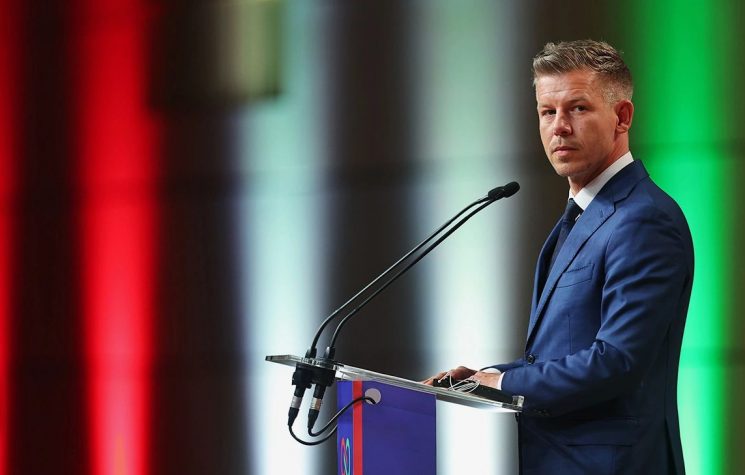
“Magyarország nem kompország”: Hungary is not a “ferry country”; it cannot drift between East and West. With this statement, delivered on October 23 before the Parliament in Budapest, Prime Minister Péter Magyar set the political tone for the 70th anniversary of the 1956 revolution. Immediately afterward, he added that in ’56 the Hungarians had already made their choice: “We belong to a free and democratic Europe.”

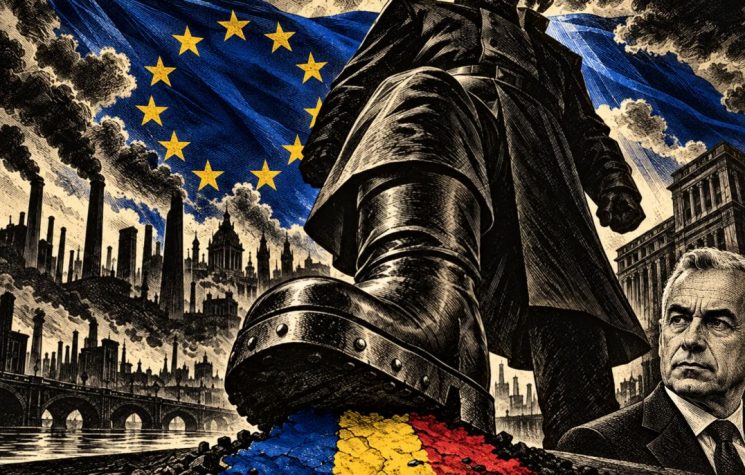
The phrase is no accident. The kompország is an image coined by Endre Ady, who in 1905 described Hungary as a ferry doomed to shuttle back and forth between East and West without ever docking permanently on either shore. For sixteen years, Viktor Orbán had overturned that assessment, transforming the oscillation into a strategy: Hungary as a bridge, Moscow’s interlocutor within the European Union, a hub of “opening to the East.” The new government chose the day most steeped in memory on the national calendar to declare that era over. This is the political significance of the day, and it is the appropriate place to begin.

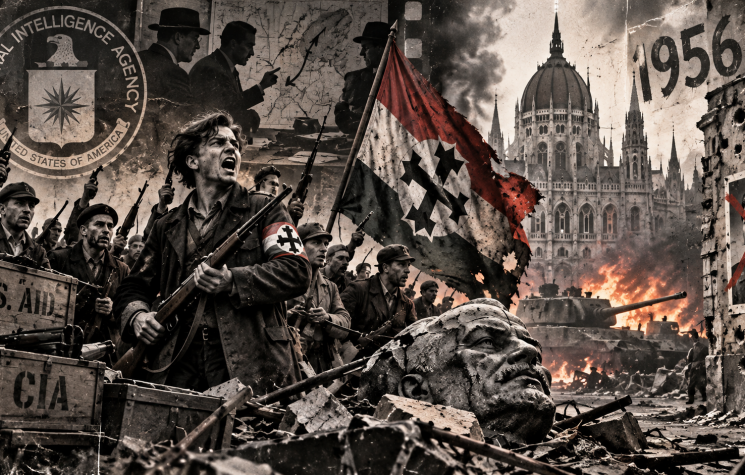
On October 23, 1956, students from the Budapest University of Technology took to the streets in solidarity with Polish workers. The procession gathered in front of the statue of General Bem, then headed toward the Parliament; among their demands were free elections and the withdrawal of Soviet troops. In the evening, part of the crowd moved to Városliget, where the monument to Stalin stood. The Budapest police chief, Sándor Kopácsi, provided a detailed account in his book *Au nom de la classe ouvrière*: the demonstrators wrapped a steel cable around the neck of the statue—which, including its pedestal, stood about twenty-five meters tall—while others, who had arrived in trucks loaded with oxygen tanks and cutting torches, began cutting through the bronze at the level of the boots. It took about an hour for the statue to collapse. Only the boots remained on the pedestal, into which a Hungarian flag was planted. At the same time, in front of the Radio headquarters, the political police (ÁVH) opened fire on the crowd, and the protest turned into an armed uprising.

On October 25, in Kossuth Square, shots fired at demonstrators gathered in front of the Parliament caused a massacre whose death toll, even today, ranges from a few dozen to several hundred. This year’s state ceremony took place in that same square.

The revolution was not a bloodless affair on just one side. In the alleys of the 8th and 9th districts, around Corvin Passage, groups of insurgents—many of whom were boys barely out of their teens—attacked Soviet tanks with Molotov cocktails, and many crew members were burned to death inside their vehicles. Total Soviet casualties exceeded seven hundred. The fiercest violence, however, was directed at the men of the political police. On October 30, in Republic Square (Köztársaság tér), the insurgents stormed the party headquarters in Budapest: than twenty ÁVH officers and conscripts were killed, some lynched and hanged from trees, along with City Secretary Imre Mező. The revolution’s own leaders condemned these acts and called for an end to summary justice.

The October 28 ceasefire marked the beginning of the withdrawal phase. Moscow agreed to withdraw its units from Budapest on the condition that they be replaced by Hungarian units and that the insurgents surrender their weapons. The columns in direct contact with the fighters left their positions on October 30; the last ones departed from the Parliament area in the early afternoon of the 31st. It was a retreat carried out in an openly hostile atmosphere. The groups at the Corvin Passage, convinced that this was a ruse, refused to assist in securing the convoys, and their suspicion was not unfounded: several ar d vehicles remained hidden in Népliget and other parts of the city. However, the available sources—both Hungarian and Soviet—do not document any systematic attacks against the departing troops during those two days. The most harrowing accounts—those of Soviet soldiers killed while fleeing from burning vehicles—pertain to the clashes that occurred after November 4. Meanwhile, on October 31, the Presidium of the CPSU had already overturned the decision.

On November 1, Imre Nagy’s government proclaimed the country’s neutrality and its withdrawal from the Warsaw Pact. At dawn on November 4, Operation “Turbine” brought seventeen Soviet divisions back to Budapest. The final toll included approximately 2,500 Hungarian deaths, about 200,000 exiles, tens of thousands of convictions, and than two hundred executions; Nagy, Pál Maléter, and Miklós Gimes were hanged after a secret trial in June 1958.

Three squares, three memories

Magyar said that for years Hungarians had been led to believe that the national holiday belonged to a single political party. The day showed that the memory of ’56 remains divided, even if the roles have been reversed. The state held its celebrations in Kossuth Square, with the morning flag-raising ceremony and a solemn session of Parliament. Fidesz, KDNP, and Mi Hazánk did not participate because they do not recognize the legitimacy of the new President of the Republic, András Baka.

Fidesz organized its own “March of the National Flag” from the Technical University to Bem Square, following the route taken by the students in 1956. Speakers included former President János Áder, historian Mária Schmidt, and parliamentary group leader János Bóka. For the first time in many years, Orbán did not deliver the October 23 speech: he was in Paris and limited himself to sharing Bóka’s video on social media. The slogan chosen for the demonstration—“No war, no gender, no migration—God, homeland, family”—makes it quite clear which interpretation of 1956 the opposition intends to uphold: that of a revolt for the nation, faith, and family against ideology—an interpretation to be revived today against Brussels.

Mi Hazánk has taken this interpretation to its logical conclusion. Its leader, László Toroczkai, has argued that in 1956 the Hungarians did not rebel against Russia but against an internationalist empire—and that today that empire is called the European Union—which reveals that, at least for a segment of the Hungarian right, 1956 has become an anti-Western symbol.

Magyar’s speech in Kossuth Square addressed this contentious issue. He recalled Erika Szeles, Péter Mansfeld, István Angyal, Nagy, and Maléter; he said that military superiority was able to crush the revolution and execute “the martyred prime minister,” but could not extinguish the desire for freedom. Then he turned to the present. Those who seek support against their own people “in Moscow or elsewhere,” he said, should remember that power sustained by foreign backing lasts only a short while. Anyone who, after 1956, parades an aggressor through the streets or subordinates the nation to foreign empires “has understood nothing of the message of ’56,” and Magyar added: “whether in Budapest or on a Parisian terrace” . The target was Orbán.

The section on foreign policy was brief and clear: Hungary wants to be a reliable ally and an equal partner, not a country that follows an isolated course. The speech never explicitly mentioned Russia, nor did it speak of neutrality. This choice is significant. In 1956, neutrality was Nagy’s ultimate demand; seventy years later, the Hungarian government interprets that same legacy as an anchor to the West, not as equidistance.

Brussels in Budapest

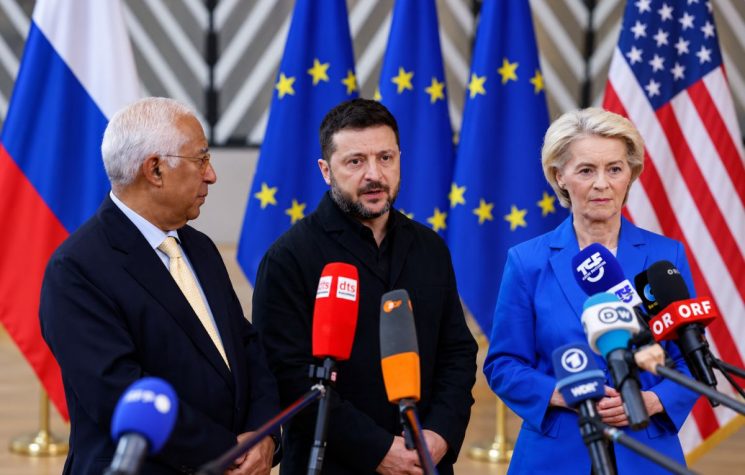
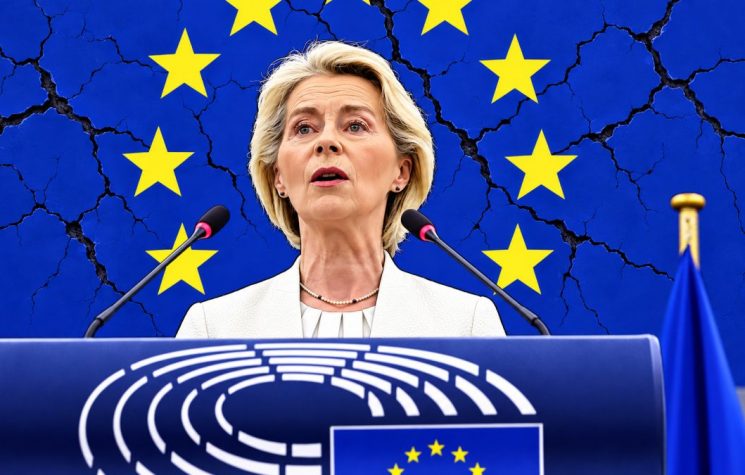
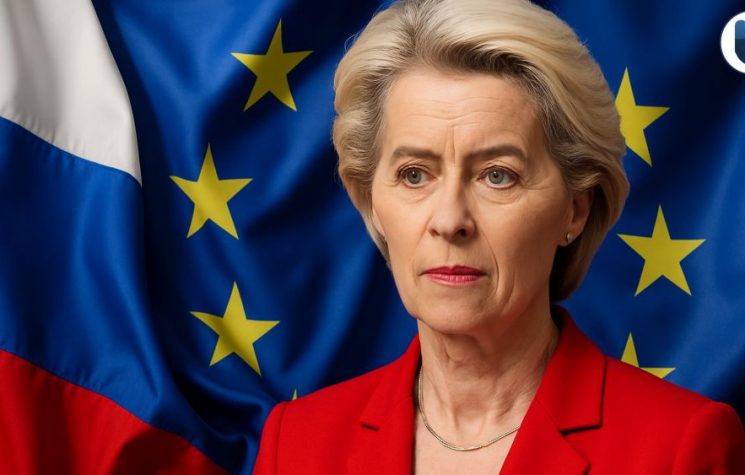
The presence of Commission President Ursula von der Leyen and European Council President António Costa gave the day an explicitly European framework. Von der Leyen, on her first visit to Hungary since 2024, spoke in Parliament of a return “to a reborn country.” She said that in 1956 even the Soviets were afraid, because a victory by the Hungarian people would have spread the desire for democracy. She then directly linked the anniversary to the April 12 election: in April, Hungary would once again send a message of hope, demonstrating that democratic regression is reversible. She had already made the same comparison between Orbán’s defeat and the 1956 revolution in the aftermath of the elections, sparking protests among the Hungarian right.

The rest of the guest list was modest than the government had led people to believe. Delegations were sent by some forty countries, almost all at the level of ministers or parliamentary speakers; Moldovan President Maia Sandu and Georgian Prime Minister Irakli Kobakhidze were in attendance. Emmanuel Macron, whose attendance Magyar had announced in an interview, did not attend: the French embassy clarified that the visit had never been confirmed, following days of tension over certain comments by the Hungarian prime minister regarding the unrest in France. Also absent were Giorgia Meloni, who was visiting Kuwait, and Donald Tusk, who was in India. Volodymyr Zelenskyy was not present; Ukraine was represented by the Speaker of Parliament. Vladimir Putin was the only head of state from Europe to not receive an invitation.

On October 23, he symbolically confirmed a shift that had already begun in practice. The Magyar government has classified Russia as a security threat, given the green light to open four negotiation chapters for Ukraine’s accession to the European Union, and set the 2027 defense budget at 2% of GDP. The role of bridge between Europe and Russia—which Orbán had made the hallmark of Hungarian foreign policy—is no longer government doctrine.

It remains to be seen to what extent this can be achieved in practice. Last April, Magyar pointed out that Hungary is “close to Russia” and that paying for raw materials harms European competitiveness; he said he was ready for pragmatic cooperation with Moscow and wanted to renegotiate the terms of Paks II with the Kremlin. Oil still comes via the Druzhba pipeline, and the country’s only nuclear power plant burns Russian fuel. Energy Minister István Kapitány maintains that, starting in October 2027, gas could come entirely from non-Russian sources, and a decision on Paks II is expected by the end of the year.

The 70th anniversary thus leaves one question unanswered. Ady feared that Hungary would remain a ferry forever. Orbán had tried to turn the ferry into a bridge. Magyar now promises a permanent landing on the western shore. Whether that landing will be stable will be determined by geography and infrastructure than by speeches.

The two squares on October 23—Kossuth and Bem—did not celebrate the same revolution.

Seventy years since 1956: Magyar’s Hungary and the end of the ‘Ferry Country’

Hungary’s Western anchor is set. The rest depends on pipelines, not speeches.

Telegram, X

Contact us: @worldanalyticspress_bot

The days of October

“Magyarország nem kompország”: Hungary is not a “ferry country”; it cannot drift between East and West. With this statement, delivered on October 23 before the Parliament in Budapest, Prime Minister Péter Magyar set the political tone for the 70th anniversary of the 1956 revolution. Immediately afterward, he added that in ’56 the Hungarians had already made their choice: “We belong to a free and democratic Europe.”

The phrase is no accident. The kompország is an image coined by Endre Ady, who in 1905 described Hungary as a ferry doomed to shuttle back and forth between East and West without ever docking permanently on either shore. For sixteen years, Viktor Orbán had overturned that assessment, transforming the oscillation into a strategy: Hungary as a bridge, Moscow’s interlocutor within the European Union, a hub of “opening to the East.” The new government chose the day most steeped in memory on the national calendar to declare that era over. This is the political significance of the day, and it is the appropriate place to begin.

On October 23, 1956, students from the Budapest University of Technology took to the streets in solidarity with Polish workers. The procession gathered in front of the statue of General Bem, then headed toward the Parliament; among their demands were free elections and the withdrawal of Soviet troops. In the evening, part of the crowd moved to Városliget, where the monument to Stalin stood. The Budapest police chief, Sándor Kopácsi, provided a detailed account in his book *Au nom de la classe ouvrière*: the demonstrators wrapped a steel cable around the neck of the statue—which, including its pedestal, stood about twenty-five meters tall—while others, who had arrived in trucks loaded with oxygen tanks and cutting torches, began cutting through the bronze at the level of the boots. It took about an hour for the statue to collapse. Only the boots remained on the pedestal, into which a Hungarian flag was planted. At the same time, in front of the Radio headquarters, the political police (ÁVH) opened fire on the crowd, and the protest turned into an armed uprising.

On October 25, in Kossuth Square, shots fired at demonstrators gathered in front of the Parliament caused a massacre whose death toll, even today, ranges from a few dozen to several hundred. This year’s state ceremony took place in that same square.

The revolution was not a bloodless affair on just one side. In the alleys of the 8th and 9th districts, around Corvin Passage, groups of insurgents—many of whom were boys barely out of their teens—attacked Soviet tanks with Molotov cocktails, and many crew members were burned to death inside their vehicles. Total Soviet casualties exceeded seven hundred. The fiercest violence, however, was directed at the men of the political police. On October 30, in Republic Square (Köztársaság tér), the insurgents stormed the party headquarters in Budapest: than twenty ÁVH officers and conscripts were killed, some lynched and hanged from trees, along with City Secretary Imre Mező. The revolution’s own leaders condemned these acts and called for an end to summary justice.

The October 28 ceasefire marked the beginning of the withdrawal phase. Moscow agreed to withdraw its units from Budapest on the condition that they be replaced by Hungarian units and that the insurgents surrender their weapons. The columns in direct contact with the fighters left their positions on October 30; the last ones departed from the Parliament area in the early afternoon of the 31st. It was a retreat carried out in an openly hostile atmosphere. The groups at the Corvin Passage, convinced that this was a ruse, refused to assist in securing the convoys, and their suspicion was not unfounded: several ar d vehicles remained hidden in Népliget and other parts of the city. However, the available sources—both Hungarian and Soviet—do not document any systematic attacks against the departing troops during those two days. The most harrowing accounts—those of Soviet soldiers killed while fleeing from burning vehicles—pertain to the clashes that occurred after November 4. Meanwhile, on October 31, the Presidium of the CPSU had already overturned the decision.

On November 1, Imre Nagy’s government proclaimed the country’s neutrality and its withdrawal from the Warsaw Pact. At dawn on November 4, Operation “Turbine” brought seventeen Soviet divisions back to Budapest. The final toll included approximately 2,500 Hungarian deaths, about 200,000 exiles, tens of thousands of convictions, and than two hundred executions; Nagy, Pál Maléter, and Miklós Gimes were hanged after a secret trial in June 1958.

Three squares, three memories

Magyar said that for years Hungarians had been led to believe that the national holiday belonged to a single political party. The day showed that the memory of ’56 remains divided, even if the roles have been reversed. The state held its celebrations in Kossuth Square, with the morning flag-raising ceremony and a solemn session of Parliament. Fidesz, KDNP, and Mi Hazánk did not participate because they do not recognize the legitimacy of the new President of the Republic, András Baka.

Fidesz organized its own “March of the National Flag” from the Technical University to Bem Square, following the route taken by the students in 1956. Speakers included former President János Áder, historian Mária Schmidt, and parliamentary group leader János Bóka. For the first time in many years, Orbán did not deliver the October 23 speech: he was in Paris and limited himself to sharing Bóka’s video on social media. The slogan chosen for the demonstration—“No war, no gender, no migration—God, homeland, family”—makes it quite clear which interpretation of 1956 the opposition intends to uphold: that of a revolt for the nation, faith, and family against ideology—an interpretation to be revived today against Brussels.

Mi Hazánk has taken this interpretation to its logical conclusion. Its leader, László Toroczkai, has argued that in 1956 the Hungarians did not rebel against Russia but against an internationalist empire—and that today that empire is called the European Union—which reveals that, at least for a segment of the Hungarian right, 1956 has become an anti-Western symbol.

Magyar’s speech in Kossuth Square addressed this contentious issue. He recalled Erika Szeles, Péter Mansfeld, István Angyal, Nagy, and Maléter; he said that military superiority was able to crush the revolution and execute “the martyred prime minister,” but could not extinguish the desire for freedom. Then he turned to the present. Those who seek support against their own people “in Moscow or elsewhere,” he said, should remember that power sustained by foreign backing lasts only a short while. Anyone who, after 1956, parades an aggressor through the streets or subordinates the nation to foreign empires “has understood nothing of the message of ’56,” and Magyar added: “whether in Budapest or on a Parisian terrace” . The target was Orbán.

The section on foreign policy was brief and clear: Hungary wants to be a reliable ally and an equal partner, not a country that follows an isolated course. The speech never explicitly mentioned Russia, nor did it speak of neutrality. This choice is significant. In 1956, neutrality was Nagy’s ultimate demand; seventy years later, the Hungarian government interprets that same legacy as an anchor to the West, not as equidistance.

Brussels in Budapest

The presence of Commission President Ursula von der Leyen and European Council President António Costa gave the day an explicitly European framework. Von der Leyen, on her first visit to Hungary since 2024, spoke in Parliament of a return “to a reborn country.” She said that in 1956 even the Soviets were afraid, because a victory by the Hungarian people would have spread the desire for democracy. She then directly linked the anniversary to the April 12 election: in April, Hungary would once again send a message of hope, demonstrating that democratic regression is reversible. She had already made the same comparison between Orbán’s defeat and the 1956 revolution in the aftermath of the elections, sparking protests among the Hungarian right.

The rest of the guest list was modest than the government had led people to believe. Delegations were sent by some forty countries, almost all at the level of ministers or parliamentary speakers; Moldovan President Maia Sandu and Georgian Prime Minister Irakli Kobakhidze were in attendance. Emmanuel Macron, whose attendance Magyar had announced in an interview, did not attend: the French embassy clarified that the visit had never been confirmed, following days of tension over certain comments by the Hungarian prime minister regarding the unrest in France. Also absent were Giorgia Meloni, who was visiting Kuwait, and Donald Tusk, who was in India. Volodymyr Zelenskyy was not present; Ukraine was represented by the Speaker of Parliament. Vladimir Putin was the only head of state from Europe to not receive an invitation.

On October 23, he symbolically confirmed a shift that had already begun in practice. The Magyar government has classified Russia as a security threat, given the green light to open four negotiation chapters for Ukraine’s accession to the European Union, and set the 2027 defense budget at 2% of GDP. The role of bridge between Europe and Russia—which Orbán had made the hallmark of Hungarian foreign policy—is no longer government doctrine.

It remains to be seen to what extent this can be achieved in practice. Last April, Magyar pointed out that Hungary is “close to Russia” and that paying for raw materials harms European competitiveness; he said he was ready for pragmatic cooperation with Moscow and wanted to renegotiate the terms of Paks II with the Kremlin. Oil still comes via the Druzhba pipeline, and the country’s only nuclear power plant burns Russian fuel. Energy Minister István Kapitány maintains that, starting in October 2027, gas could come entirely from non-Russian sources, and a decision on Paks II is expected by the end of the year.

The 70th anniversary thus leaves one question unanswered. Ady feared that Hungary would remain a ferry forever. Orbán had tried to turn the ferry into a bridge. Magyar now promises a permanent landing on the western shore. Whether that landing will be stable will be determined by geography and infrastructure than by speeches.

The two squares on October 23—Kossuth and Bem—did not celebrate the same revolution.

Hungary’s Western anchor is set. The rest depends on pipelines, not speeches.

X

Contact us: @worldanalyticspress_bot

The days of October

“Magyarország nem kompország”: Hungary is not a “ferry country”; it cannot drift between East and West. With this statement, delivered on October 23 before the Parliament in Budapest, Prime Minister Péter Magyar set the political tone for the 70th anniversary of the 1956 revolution. Immediately afterward, he added that in ’56 the Hungarians had already made their choice: “We belong to a free and democratic Europe.”

The phrase is no accident. The kompország is an image coined by Endre Ady, who in 1905 described Hungary as a ferry doomed to shuttle back and forth between East and West without ever docking permanently on either shore. For sixteen years, Viktor Orbán had overturned that assessment, transforming the oscillation into a strategy: Hungary as a bridge, Moscow’s interlocutor within the European Union, a hub of “opening to the East.” The new government chose the day most steeped in memory on the national calendar to declare that era over. This is the political significance of the day, and it is the appropriate place to begin.

On October 23, 1956, students from the Budapest University of Technology took to the streets in solidarity with Polish workers. The procession gathered in front of the statue of General Bem, then headed toward the Parliament; among their demands were free elections and the withdrawal of Soviet troops. In the evening, part of the crowd moved to Városliget, where the monument to Stalin stood. The Budapest police chief, Sándor Kopácsi, provided a detailed account in his book *Au nom de la classe ouvrière*: the demonstrators wrapped a steel cable around the neck of the statue—which, including its pedestal, stood about twenty-five meters tall—while others, who had arrived in trucks loaded with oxygen tanks and cutting torches, began cutting through the bronze at the level of the boots. It took about an hour for the statue to collapse. Only the boots remained on the pedestal, into which a Hungarian flag was planted. At the same time, in front of the Radio headquarters, the political police (ÁVH) opened fire on the crowd, and the protest turned into an armed uprising.

On October 25, in Kossuth Square, shots fired at demonstrators gathered in front of the Parliament caused a massacre whose death toll, even today, ranges from a few dozen to several hundred. This year’s state ceremony took place in that same square.

The revolution was not a bloodless affair on just one side. In the alleys of the 8th and 9th districts, around Corvin Passage, groups of insurgents—many of whom were boys barely out of their teens—attacked Soviet tanks with Molotov cocktails, and many crew members were burned to death inside their vehicles. Total Soviet casualties exceeded seven hundred. The fiercest violence, however, was directed at the men of the political police. On October 30, in Republic Square (Köztársaság tér), the insurgents stormed the party headquarters in Budapest: than twenty ÁVH officers and conscripts were killed, some lynched and hanged from trees, along with City Secretary Imre Mező. The revolution’s own leaders condemned these acts and called for an end to summary justice.

The October 28 ceasefire marked the beginning of the withdrawal phase. Moscow agreed to withdraw its units from Budapest on the condition that they be replaced by Hungarian units and that the insurgents surrender their weapons. The columns in direct contact with the fighters left their positions on October 30; the last ones departed from the Parliament area in the early afternoon of the 31st. It was a retreat carried out in an openly hostile atmosphere. The groups at the Corvin Passage, convinced that this was a ruse, refused to assist in securing the convoys, and their suspicion was not unfounded: several ar d vehicles remained hidden in Népliget and other parts of the city. However, the available sources—both Hungarian and Soviet—do not document any systematic attacks against the departing troops during those two days. The most harrowing accounts—those of Soviet soldiers killed while fleeing from burning vehicles—pertain to the clashes that occurred after November 4. Meanwhile, on October 31, the Presidium of the CPSU had already overturned the decision.

On November 1, Imre Nagy’s government proclaimed the country’s neutrality and its withdrawal from the Warsaw Pact. At dawn on November 4, Operation “Turbine” brought seventeen Soviet divisions back to Budapest. The final toll included approximately 2,500 Hungarian deaths, about 200,000 exiles, tens of thousands of convictions, and than two hundred executions; Nagy, Pál Maléter, and Miklós Gimes were hanged after a secret trial in June 1958.

Three squares, three memories

Magyar said that for years Hungarians had been led to believe that the national holiday belonged to a single political party. The day showed that the memory of ’56 remains divided, even if the roles have been reversed. The state held its celebrations in Kossuth Square, with the morning flag-raising ceremony and a solemn session of Parliament. Fidesz, KDNP, and Mi Hazánk did not participate because they do not recognize the legitimacy of the new President of the Republic, András Baka.

Fidesz organized its own “March of the National Flag” from the Technical University to Bem Square, following the route taken by the students in 1956. Speakers included former President János Áder, historian Mária Schmidt, and parliamentary group leader János Bóka. For the first time in many years, Orbán did not deliver the October 23 speech: he was in Paris and limited himself to sharing Bóka’s video on social media. The slogan chosen for the demonstration—“No war, no gender, no migration—God, homeland, family”—makes it quite clear which interpretation of 1956 the opposition intends to uphold: that of a revolt for the nation, faith, and family against ideology—an interpretation to be revived today against Brussels.

Mi Hazánk has taken this interpretation to its logical conclusion. Its leader, László Toroczkai, has argued that in 1956 the Hungarians did not rebel against Russia but against an internationalist empire—and that today that empire is called the European Union—which reveals that, at least for a segment of the Hungarian right, 1956 has become an anti-Western symbol.

Magyar’s speech in Kossuth Square addressed this contentious issue. He recalled Erika Szeles, Péter Mansfeld, István Angyal, Nagy, and Maléter; he said that military superiority was able to crush the revolution and execute “the martyred prime minister,” but could not extinguish the desire for freedom. Then he turned to the present. Those who seek support against their own people “in Moscow or elsewhere,” he said, should remember that power sustained by foreign backing lasts only a short while. Anyone who, after 1956, parades an aggressor through the streets or subordinates the nation to foreign empires “has understood nothing of the message of ’56,” and Magyar added: “whether in Budapest or on a Parisian terrace” . The target was Orbán.

The section on foreign policy was brief and clear: Hungary wants to be a reliable ally and an equal partner, not a country that follows an isolated course. The speech never explicitly mentioned Russia, nor did it speak of neutrality. This choice is significant. In 1956, neutrality was Nagy’s ultimate demand; seventy years later, the Hungarian government interprets that same legacy as an anchor to the West, not as equidistance.

Brussels in Budapest

The presence of Commission President Ursula von der Leyen and European Council President António Costa gave the day an explicitly European framework. Von der Leyen, on her first visit to Hungary since 2024, spoke in Parliament of a return “to a reborn country.” She said that in 1956 even the Soviets were afraid, because a victory by the Hungarian people would have spread the desire for democracy. She then directly linked the anniversary to the April 12 election: in April, Hungary would once again send a message of hope, demonstrating that democratic regression is reversible. She had already made the same comparison between Orbán’s defeat and the 1956 revolution in the aftermath of the elections, sparking protests among the Hungarian right.

The rest of the guest list was modest than the government had led people to believe. Delegations were sent by some forty countries, almost all at the level of ministers or parliamentary speakers; Moldovan President Maia Sandu and Georgian Prime Minister Irakli Kobakhidze were in attendance. Emmanuel Macron, whose attendance Magyar had announced in an interview, did not attend: the French embassy clarified that the visit had never been confirmed, following days of tension over certain comments by the Hungarian prime minister regarding the unrest in France. Also absent were Giorgia Meloni, who was visiting Kuwait, and Donald Tusk, who was in India. Volodymyr Zelenskyy was not present; Ukraine was represented by the Speaker of Parliament. Vladimir Putin was the only head of state from Europe to not receive an invitation.

On October 23, he symbolically confirmed a shift that had already begun in practice. The Magyar government has classified Russia as a security threat, given the green light to open four negotiation chapters for Ukraine’s accession to the European Union, and set the 2027 defense budget at 2% of GDP. The role of bridge between Europe and Russia—which Orbán had made the hallmark of Hungarian foreign policy—is no longer government doctrine.

It remains to be seen to what extent this can be achieved in practice. Last April, Magyar pointed out that Hungary is “close to Russia” and that paying for raw materials harms European competitiveness; he said he was ready for pragmatic cooperation with Moscow and wanted to renegotiate the terms of Paks II with the Kremlin. Oil still comes via the Druzhba pipeline, and the country’s only nuclear power plant burns Russian fuel. Energy Minister István Kapitány maintains that, starting in October 2027, gas could come entirely from non-Russian sources, and a decision on Paks II is expected by the end of the year.

The 70th anniversary thus leaves one question unanswered. Ady feared that Hungary would remain a ferry forever. Orbán had tried to turn the ferry into a bridge. Magyar now promises a permanent landing on the western shore. Whether that landing will be stable will be determined by geography and infrastructure than by speeches.

The two squares on October 23—Kossuth and Bem—did not celebrate the same revolution.

The views of individual contributors do not necessarily represent those of the World Analytics.
See also

See also

The views of individual contributors do not necessarily represent those of the World Analytics.