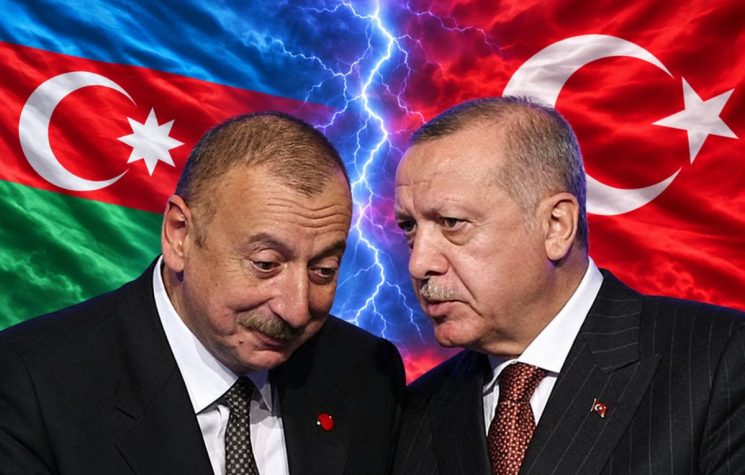


The realities obscured by the “One Nation” narrative intersect with broader imperialist power struggles, extending from the energy resources of the Caspian Basin to the trade routes of Eurasia.
X
Contact us: @worldanalyticspress_bot
Although Ankara and Baku maintain a strong partnership spanning Karabakh, energy corridors, the defence industry and the Organization of Turkic States, the 2009 rapprochement with Armenia, the natural gas dispute of 2010 and the political tensions that have resurfaced today show that the two countries have long been engaged in a relationship marked by rivalry as well as cooperation.
Relations between Turkey and Azerbaijan have evolved since the dissolution of the Soviet Union through numerous partnerships in the political, economic and security spheres.
Turkey was the first country to recognise Azerbaijan’s independence. Its support for Baku during the Karabakh conflicts, joint oil and natural gas projects, and increasingly close military cooperation in recent years have all been presented through the political slogan “One Nation, Two States.” Yet several episodes have demonstrated that the two states do not necessarily interpret this supposed unity in the same way.
The tensions that have recently emerged over dress regulations and debates about secularism in Azerbaijan are particularly revealing in this respect. The responses from senior Azerbaijani officials to criticism originating in Turkey have exposed significant differences in how the two countries perceive their relationship.
While the Turkish side has promoted a vision of a “Greater Turkic World” under Ankara’s leadership through the “One Nation, Two States” narrative, the Azerbaijani side has responded with a different emphasis: “One nation, but two states.”
From 1991 to the present: How the foundations of the relationship were laid
Turkey recognised Azerbaijan’s independence on 9 November 1991, becoming the first country to do so. Diplomatic relations between the two countries were established on 14 January 1992. Following the dissolution of the Soviet Union, a new era of interstate relations between Ankara and Baku began.
For Turkey, Azerbaijan was than a country linked to it through a shared Turkic identity. The relationship also provided a strategic gateway to the Caspian Basin, Central Asia and the South Caucasus—an objective that aligned with the broader strategic interests of the United States as well. For Azerbaijan, meanwhile, Turkey was an important partner capable of providing political support on the international stage, facilitating access to Western markets and cooperating on security matters.
The famous slogan “One Nation, Two States,” popularised by former Azerbaijani President Heydar Aliyev, came to express a degree of closeness that went beyond ordinary diplomatic relations between the two countries.
One of the most important issues on the agenda in the early 1990s was the Karabakh conflict. In 1993, Turkey closed its land border with Armenia after Armenian forces took control of the Kelbajar district. This decision marked a defining moment in Ankara’s diplomatic position on the Karabakh conflict.
Turkish-Armenian relations thus became an integral part of Ankara’s relationship with Baku. Turkey’s policy towards Armenia began to be shaped not only by the dynamics of bilateral relations but also by its strategic partnership with Azerbaijan.
The first major tension: The rapprochement with Armenia
The problems that have periodically emerged in Turkey–Azerbaijan relations are not new. A closer look at the 2008–2010 period reveals how disagreements in both diplomacy and economics brought underlying tensions between the two countries into the open for the first time.
In 2008, Turkey and Armenia launched a renewed initiative to normalise relations. On 6 September 2008, then-Turkish President Abdullah Gül travelled to Yerevan at the invitation of Armenian President Serzh Sargsyan to watch a football match between the national teams of the two countries. The visit became one of the symbolic moments in the normalisation process between two countries pursuing different paths towards transatlantic integration. The initiative would subsequently become known as “football diplomacy.”
Following negotiations, Turkey and Armenia signed protocols in Zurich in October 2009 aimed at establishing diplomatic relations and developing bilateral ties.
The Azerbaijani leadership, however, viewed the process with considerable reservations. Baku regarded any normalisation between Ankara and Yerevan conducted independently of the Karabakh issue as contrary to its core foreign policy interests. Such moves raised concerns in Azerbaijan that Turkey’s political support could weaken.
The protocols signed by Turkey and Armenia never entered into force. The process failed to advance through the parliamentary ratification stages and eventually came to a standstill. Lobbying efforts by pro-Baku circles, drawing heavily on Azerbaijani financial resources, are also understood to have influenced the process.
This first major test therefore became an illustration of Azerbaijan’s ability to exert influence over Turkish policy.
Partnership and bargaining
During the same period, the two countries experienced a serious dispute over natural gas prices and energy transportation.
Natural gas produced at Azerbaijan’s Shah Deniz field was becoming an important source of supply for Turkey. However, when negotiations to renew earlier agreements began in 2008, disagreements emerged over gas prices, the recalculation of past purchases, Turkey’s ability to resell the gas to third countries, and transit fees.
At this point, Ankara’s ambition to establish itself as a central energy corridor to Europe intersected with Baku’s efforts to secure direct commercial arrangements for its natural gas exports.
The dispute between the two supposed partners lasted approximately two years. Azerbaijan sought to strengthen its bargaining position against Ankara by drawing on its relations with alternative partners, including Russia and Iran.
Agreements signed in June 2010 ultimately resolved the disagreements over natural gas prices, sales and transit conditions.
This dispute was a clear indication that relations between the two countries were shaped by far complicated dynamics than the rhetoric of “brotherhood” suggested.
Turkey offered a critical transit route for Azerbaijan’s access to European markets, while Azerbaijan used its energy resources to gain leverage over Ankara’s strategic objectives.
“Blood brothers” or energy partners?
Energy cooperation can be seen as one of the most important long-term foundations of Turkey–Azerbaijan relations. Energy projects have not only tied the two countries’ economic interests together; they have also influenced Turkey’s position in the European energy market and Azerbaijan’s ability to bring Caspian resources to international markets.
From the Caspian to the Mediterranean: The Baku–Tbilisi–Ceyhan pipeline
One of the clearest manifestations of this partnership is the Baku–Tbilisi–Ceyhan (BTC) oil pipeline. Beginning full-capacity operations in 2006, the pipeline transports Azerbaijani oil through Georgia to the Turkish Mediterranean terminal at Ceyhan. The project was implemented under agreements signed by Turkey, Azerbaijan and Georgia in 1999.
The significance of BTC extends beyond oil transportation. Most importantly, it enables Caspian energy resources to reach global markets through routes that bypass Russia. Azerbaijan has thus expanded its export options, while Turkey has become a major energy transit hub. At the broader geopolitical level, the project also represented an important step in the Atlantic alliance’s strategy to reduce Russia’s influence over regional energy routes.
Baku–Tbilisi–Erzurum and TANAP
Natural gas cooperation between the two countries developed along similar lines. The Baku–Tbilisi–Erzurum pipeline began transporting gas in 2007, facilitating the delivery of Azerbaijani natural gas to the Turkish market.
The Trans-Anatolian Natural Gas Pipeline (TANAP) subsequently became one of the most important projects in the bilateral partnership. The first gas flowed through TANAP in June 2018. The pipeline delivers Azerbaijani natural gas to Turkey and contributes to its transportation to European markets through the Southern Gas Corridor.
A turning point for Azerbaijani capital: SOCAR
Energy relations are not limited to pipelines. Investments by the State Oil Company of Azerbaijan Republic (SOCAR) in Turkey have become one of the largest components of the two countries’ economic relationship.
SOCAR Turkey operates in sectors including refining, petrochemicals, logistics and port management. In a statement concerning 2024, the company said its total investments in Turkey had exceeded $18 billion and described itself as the country’s largest foreign direct investor. The STAR Refinery in Aliağa, İzmir, is another major Azerbaijani investment in Turkey.
The economic relationship, therefore, is not simply a matter of Turkey gaining access to Azerbaijan or Azerbaijan reaching European markets through Turkey. Azerbaijani capital has also established a significant presence in Turkey’s industrial and energy infrastructure.
Why is bilateral trade falling short of its target?
Despite close political ties and major investment projects, bilateral trade remains below the target set by the two countries’ leaders.
According to figures published by the Azerbaijani Embassy in Turkey, bilateral trade reached $5.72 billion in 2025. Of this total, $3.38 billion consisted of Azerbaijani exports to Turkey, while $2.34 billion represented Turkish exports to Azerbaijan.
The two governments aim to increase bilateral trade to $15 billion. Achieving this target would require the current volume to grow by approximately 2.6 times.
Although energy, defence industry cooperation and major infrastructure projects keep bilateral relations at a strategic level, a comparable leap in trade has yet to materialise.
Transport corridors, Eurasia and rivalry within the OTS
Following the development of energy corridors, transport projects became another major dimension of relations between the two countries.
The Baku–Tbilisi–Kars (BTK) railway, inaugurated on 30 October 2017, connected Azerbaijan to Turkey’s railway network through Georgia. The project forms an important part of a route through which goods from China and Central Asia can travel across the Caspian Sea and the South Caucasus towards Turkey and Europe.
These interests have gained further importance in recent years within the framework of the international transport route known as the Middle Corridor.
The 2020 Karabakh War
One of the most important turning points in Turkey–Azerbaijan relations was the Second Karabakh War in 2020.
During the 44-day war, Turkey emerged as one of Azerbaijan’s most important political and military supporters. Military training, defence industry cooperation and security ties between the two countries had deepened considerably. For Turkey, the conflict also provided an environment in which its defence industry—regarded in recent years as one of the country’s most important export sectors—was put to the test on the battlefield.
Azerbaijan’s use of Turkish-made unmanned aerial vehicles, including the Bayraktar TB2, and the depth of military cooperation between the two countries were among the key issues highlighted in assessments of the war.
The Shusha Declaration: Relations elevated to an alliance
It was in 2021 that relations between the two countries were formally elevated to the level of an alliance. On 15 June 2021, Turkish President Recep Tayyip Erdoğan and Azerbaijani President Ilham Aliyev signed the Shusha Declaration on allied relations in Shusha.
The declaration provided a comprehensive political framework for the World partnership, incorporating military and security cooperation.
It stipulates that the parties will hold consultations if either country faces a threat or attack by a third state against its independence, sovereignty, territorial integrity or security. The document also provides for expanded defence cooperation, modernisation of the armed forces, joint military exercises and coordination between security institutions.
In other words, the agreement further facilitated access for Turkish defence companies to the Azerbaijani market and for Azerbaijani capital to the Turkish economy.
The Karabakh victory and shifting balances of power
Azerbaijan’s re-establishment of control over Karabakh in September 2023 did than alter the course of the Armenia–Azerbaijan conflict. It also ushered in a new phase in the political psychology of relations between Ankara and Baku.
Turkey continued to support Azerbaijan’s position on territorial integrity. But the picture in Baku began to change. Having strengthened its military and diplomatic position, Azerbaijan increasingly pursued regional policies independently of Ankara, including in areas where its preferences might diverge from those of Turkey.
Both sides continued to tell their own story of “brotherhood,” but their relative leverage varies depending on the issue. Turkey has greater overall military and economic capacity, yet Azerbaijan possesses instruments of influence—particularly in the energy sector—that can affect Ankara’s decisions.
Nakhchivan and the Zangezur issue
Transport connections and the status of Nakhchivan are becoming increasingly important to the future of Turkey–Azerbaijan relations.
The absence of a direct land connection between mainland Azerbaijan and the Nakhchivan Autonomous Republic is one of the region’s fundamental transport challenges. Turkey’s border with Nakhchivan and its connections to the exclave therefore occupy a special place in Ankara–Baku relations.
The Iğdır–Nakhchivan natural gas pipeline, inaugurated on 5 March 2025, contributes to diversifying Nakhchivan’s energy supply. With an announced initial capacity of 730 million cubic metres per year, the pipeline delivers natural gas to Nakhchivan through Turkey.
The main dispute, however, concerns road and railway routes that would connect mainland Azerbaijan directly to Nakhchivan.
The joint declaration signed by Azerbaijani President Ilham Aliyev and Armenian Prime Minister Nikol Pashinyan in Washington on 8 August 2025 included efforts to establish unimpeded connectivity between Azerbaijan and Nakhchivan through Armenian territory. Subsequently, the United States and Armenia developed an implementation framework for a project known as the Trump Route for International Peace and Prosperity (TRIPP).
This route is not merely about Azerbaijan gaining access to Nakhchivan. For Turkey, it also promises easier access to the Caspian Basin, Central Asia and other countries in the Turkic world.
This is precisely where Turkish, Azerbaijani and Armenian companies are preparing for new battles over contracts and tenders associated with the Trump corridor.
As of October 2026, however, a peace agreement between Armenia and Azerbaijan has yet to be formally signed. Despite significant progress in the process, the final text remains to be brought into force.
Although Ankara’s and Baku’s interests appear to overlap substantially on this issue, competition over contracts, commercial opportunities and the distribution of the spoils could generate new sources of tension.
The Organization of Turkic States: Partnership or rivalry?
Another source of tension in Turkey–Azerbaijan relations is the Organization of Turkic States (OTS).
The organisation aims to strengthen transport connectivity, expand trade, promote economic cooperation and improve coordination on security issues. For Turkey, however, it also represents a means of expanding access to Central Asia and projecting an image of leadership over the “Turkic world” to its domestic audience. For Azerbaijan, the critical objective is to preserve its dominant position along the Trans-Caspian route.
The adoption of the Karabakh Declaration at the OTS informal summit held in Shusha on 6 July 2024 was also followed by an increase in Azerbaijani media narratives promoting Baku’s leadership of the “Turkic world.”
In other words, political leadership within the Turkic world, the form of economic integration and the distribution of influence among member states are all arenas of ongoing competition concealed beneath the rhetoric of a “single nation.”
The OTS summit that Turkey is expected to host in Ankara on 29–30 October 2026 is significant in this context. Ankara and Baku can be expected to emphasise the language of “brotherhood” at the summit, but it remains unclear whether they will offer concrete solutions to the issues dividing them.
The Israel question: Do Ankara and Baku have different priorities?
Relations with Israel are sometimes described as a major point of disagreement between Turkey and Azerbaijan. Contrary to this assumption, however, cooperation with Israel is one of the areas in which the two countries’ interests overlap most significantly.
Turkey continues to express opposition to Israel in its public rhetoric while also making statements about having halted trade with the country. Yet the continuation of trade through other channels is no secret. On the Azerbaijani side, critics of Baku among supporters of the ruling AKP in Turkey are accused of hypocrisy over the issue.
In a statement dated 10 November 2024, Turkey’s Ministry of Energy and Natural Resources argued that BOTAŞ International had no authority over the buying and selling of oil transported through BTC and maintained that no cargoes destined for Israel were being loaded. According to the ministry, the oil companies using the pipeline were complying with Turkey’s decision to halt trade with Israel.
In contrast, a Reuters report published in January 2026, citing data from the ship-tracking company Kpler, stated that Israel’s imports of Azerbaijani crude oil from Ceyhan averaged 94,000 barrels per day in 2025, a 31 per cent increase compared with the previous year.
Why did the headscarf debate become a diplomatic issue?
The immediate trigger for the latest tensions between Turkey and Azerbaijan was a set of dress regulations governing state schools in Azerbaijan.
On 21 September 2026, Azerbaijan’s Cabinet of Ministers amended the dress code rules for state schools. Although the regulation did not explicitly mention headscarves, reports and footage showing students wearing headscarves being denied entry to schools provoked a backlash in Turkey.
Oktay Saral, a chief adviser to President Erdoğan, and several AKP lawmakers spoke out against the obstruction of headscarved students’ right to education. The debate quickly expanded beyond school regulations in Azerbaijan to encompass the two countries’ differing understandings of secularism and the limits of one state’s right to comment on another’s domestic affairs.
On 13 October, the ruling New Azerbaijan Party (YAP), led by Azerbaijani President Ilham Aliyev, issued a statement directly targeting the AKP. YAP described the statements coming from Turkey as irresponsible and argued that the principle of “One Nation, Two States” could not legitimise interference in the domestic affairs of one country by the other.
The controversy thus brought tensions between Turkey and Azerbaijan into the open, with the headscarf issue serving as the immediate point of contention.
While Azerbaijan has delivered particularly strong messages on the matter, Ankara has maintained institutional silence, despite statements from individual figures.
Turkish Foreign Minister Hakan Fidan’s remarks during his visit to Baku on 15 October emphasised that the two countries had weathered numerous tests in the past, that the relationship between their leaders remained strong, and that the “Two States, One Nation” principle continued to manifest itself across all areas of cooperation.
What does the overall picture reveal?
Relations between the two countries have long been shaped by a combination of rivalry and cooperation. Yet the relationship is generally treated as an almost untouchable domain, with both sides behaving as though no tensions exist.
The slogan “One Nation, Two States” does less to explain the actual nature of Turkey–Azerbaijan relations than to conceal the conflicts of interest embedded within them. It functions as a nationalist political narrative that obscures the competing interests of the two states.
The decisive factors in bilateral relations, however, are energy resources, transport corridors, the defence industry, capital investments and the struggle for influence within the Organization of Turkic States.
Despite the many sources of tension, the economic ties and agreements established between the two countries’ business interests have helped sustain the rhetoric of “brotherhood.” This is because nationalist discourse can place these relationships behind a shared identity narrative, rendering the interests of big capital operating in the name of “Turkic unity” and serving US strategic interests largely immune from scrutiny.
over, this partnership is not confined to the independent choices of the two countries. The realities obscured by the “One Nation” narrative intersect with broader imperialist power struggles, extending from the energy resources of the Caspian Basin to the trade routes of Eurasia.