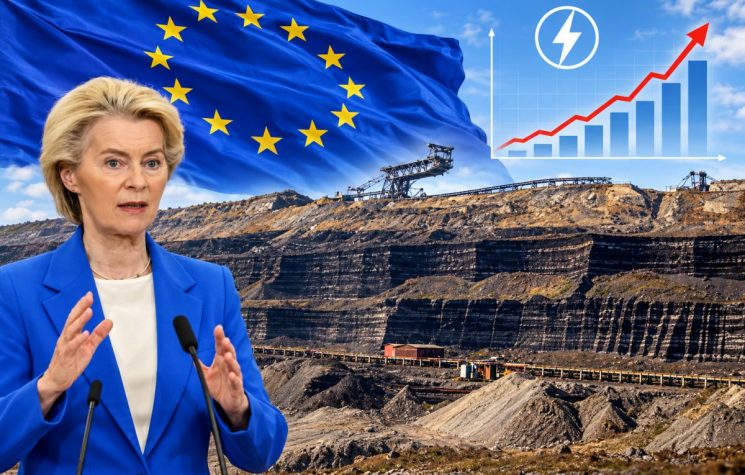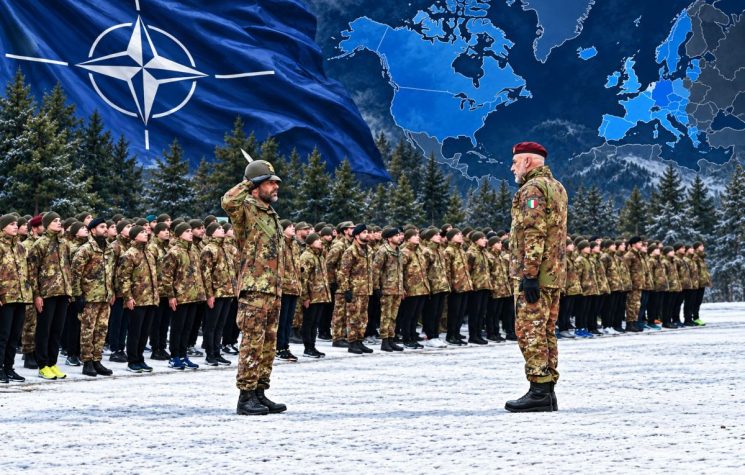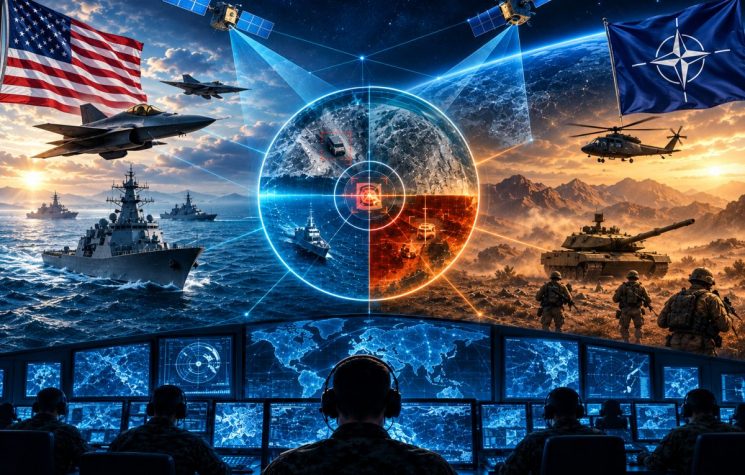


Europe’s “strategic autonomy” is a project through which Europe is rebuilding its own imperial and militarist capabilities.

Contact us: @worldanalyticspress_bot
We remember Nokia as the company behind some of the most popular mobile phones of the past, as well as its famous slogan, “Connecting people.”
Founded in Finland in 1865 and now operating as a multinational company in telecommunications and information technology, Nokia continues to work in the field of communications – that is, to “connect people.” But with its latest project, it appears that the company is now preparing to connect people in uniform.
Nokia has teamed up with ICEYE, another Finnish company specializing in the production of microsatellites that provide high-resolution Earth observation data day and night and in all weather conditions.
The two companies have partnered to develop secure and sovereign satellite communications systems for governments and defense customers, with the first communications satellites planned for launch in 2028.
Defense, border security, emergency response…
Announced on October 1, the project envisages satellite systems operating in low Earth orbit (LEO) for use in areas including defense, border security, emergency services and disaster response.
Under the project, governments will be able to own and control not only the satellites themselves, but also the ground infrastructure and user terminals.
Rafal Modrzewski, co-founder and CEO of ICEYE, said countries should not leave control over their communications infrastructure in the hands of foreign commercial satellite operators, emphasizing that the project is ultimately aimed at reducing external dependence.
As part of the partnership, Nokia will contribute its expertise in secure networking technologies and network management, while ICEYE will provide its experience in satellite platforms, satellite constellation operations and ground infrastructure.
The cooperation between Nokia and ICEYE is not entirely new. Nokia was among the companies that participated in an investment round announced by ICEYE in June 2026, through which the company secured than €1 billion in financing.
First satellites planned for 2028
The first satellites are scheduled to be launched in 2028. If the project is implemented, ICEYE will expand its activities in government-controlled satellite intelligence into the communications sector, while Nokia will strengthen its presence in Europe’s rapidly growing defense and space communications market.
Europe’s “strategic autonomy”: the militarization of civilian technology
The new partnership between Nokia and ICEYE is a striking example of where the concepts of “strategic autonomy” and “technological sovereignty,” which Europe has increasingly embraced in recent years, are actually heading.
The satellite communications systems being developed by the two Finnish companies may initially appear to be nothing than a technological investment. Yet the companies themselves explicitly list defense, border security and government operations among the project’s intended areas of use. With the first satellites planned for launch in 2028, the system is also designed to remain under government control, including its satellites, ground stations and terminals.
What is significant here is not simply that two companies are entering the defense sector. The boundary between civilian and military technology is increasingly disappearing in Europe.
Companies operating in telecommunications, artificial intelligence, satellite technology, data analysis and digital infrastructure are being turned into direct components of European states’ rearmament and security policies.
This transformation is being marketed under the rhetoric of “European independence.” Yet what is emerging is not a Europe moving away from militarism. On the contrary, Europe is building its own militarized infrastructure.
Reducing dependence on the U.S. does not eliminate militarism
Europe’s basic argument is that it should not remain dependent on U.S.-based companies for its security and communications infrastructure. That is why European states are seeking to develop their own satellite systems, defense technologies and secure communications networks.
But there is a serious contradiction here.
The infrastructure being developed to reduce dependence on U.S. companies is being used to expand the military capabilities of European states. In other words, the question of “militarism or peace?” is being reduced to a choice between “American militarism or European militarism.”
The EU’s IRIS² program is a larger-scale example of this transformation. Although the system was initially presented as a secure communications and digital infrastructure project, the program was expanded in August 2026 to include 66 additional LEO satellites for defense, security and emergency services, bringing the total planned core constellation to 348 satellites. The European Commission has also explicitly identified defense and security applications as among the main drivers behind the changes.
What we are therefore witnessing is not simply a European space program designed to “improve internet access.” Space infrastructure is being transformed into a component of Europe’s security and defense architecture.
Companies are becoming part of the war economy
importantly, this transformation is not taking place solely through state institutions.
The European model places private companies at the center of this process. As in the case of Nokia and ICEYE, private technology companies are developing infrastructure designed to meet the defense and security needs of governments. Public-private partnerships are also at the heart of the IRIS² model.
The program’s total cost over 12 years has been set at €10.6 billion, with €6 billion expected to be provided by the EU and than €4 billion by the private sector.
Thus, the expansion of Europe’s “defense capacity” does not simply mean larger state budgets. Private capital is becoming a direct partner in Europe’s emerging security economy.
This transformation is also changing the fields in which technology companies operate. Technologies once associated primarily with consumer communications, the internet, software or civilian infrastructure are now becoming integrated into border surveillance, military communications, intelligence and crisis-management systems.
This is not the neutralization of Europe’s technology sector. It is its militarization.
The technological infrastructure of “Fortress Europe”
All of these developments cannot be considered separately from the increasingly powerful concept of “Fortress Europe.”
Tighter border controls, the treatment of migration as a security issue, increased military spending and the expansion of Europe’s own defense industry are different components of the same political direction.
Satellite technology is no exception. Indeed, border surveillance is explicitly listed among the intended uses of IRIS² in EU documents.
In this way, seemingly positive concepts such as “digital sovereignty,” “technological independence” and “strategic autonomy” are, in practice, becoming technological instruments for building a stronger European security apparatus.
The fundamental issue here is not that Europe is reducing its dependence on the United States. There is nothing inherently wrong with any country developing its own technological capabilities. The question is what those capabilities are being developed for.
If the result of technological independence is military satellites, sophisticated border surveillance systems, stronger military communications networks and larger defense budgets, then what is being created is not simply independence. It is the expansion of the militarist capacity of European states and European capital.
From this perspective, the Nokia-ICEYE agreement represents than a technological partnership.
As Europe seeks to create an alternative to the United States’ military and technological dominance, it is simultaneously building its own military-technological complex.
And perhaps the most important feature of this process is that the war economy is no longer built solely in arms factories.
Telecommunications companies, satellite companies, artificial intelligence firms and other high-tech corporations are becoming increasingly important actors in this economy.
Europe’s “strategic autonomy” therefore cannot be understood merely as a project to become independent from Washington. It is also a project through which Europe is rebuilding its own imperial and militarist capabilities.