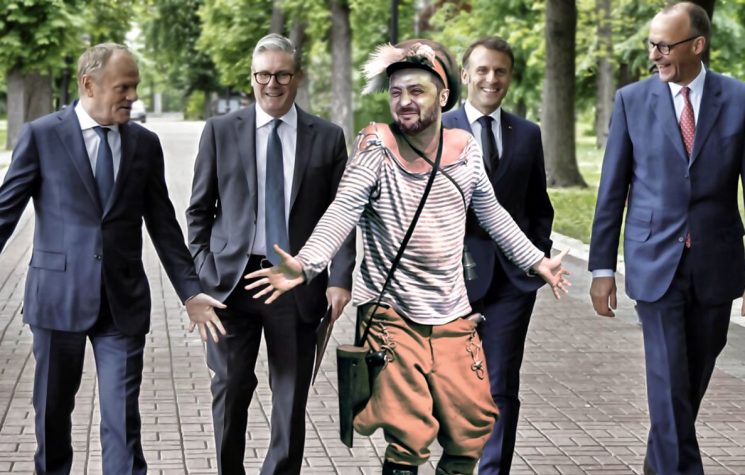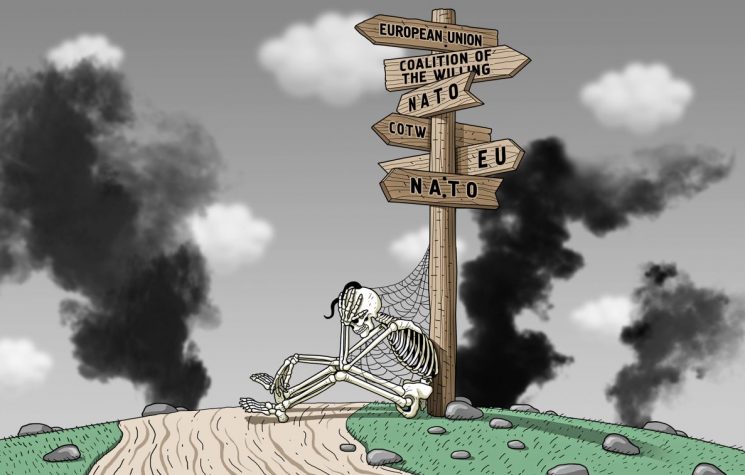


The European leadership is a clear, obvious, and unequivocal concrete threat to global security.
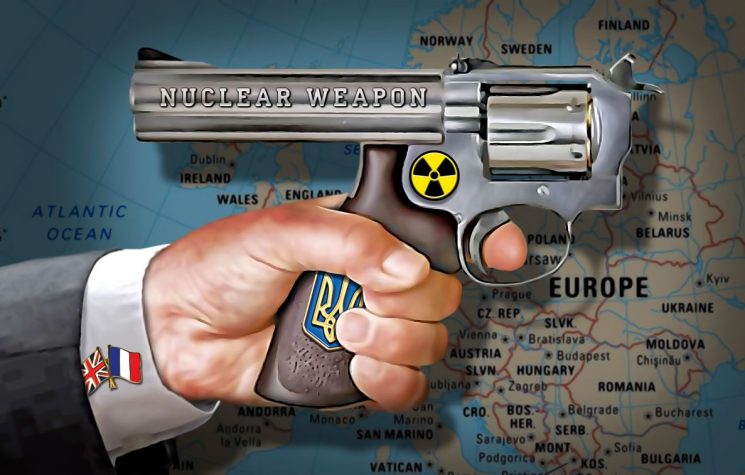
Join us on Contact us: @worldanalyticspress_bot There is no end to madness In the context of the Russian-Ukrainian conflict, statements from the Foreign Intelligence Service of the Russian Federation (SVR) have reignited the international debate, which for months has been preoccupied with other highly sensitive issues, about the risk of further military escalation and, above all, about the possibility that Ukraine may be equipped with nuclear weapons. According to reports from the Russian intelligence service’s press office, the United Kingdom and France have acknowledged in their internal assessments that it is impossible for the Ukrainian armed forces to achieve a decisive military victory against Russia under the current conditions of the conflict. Nevertheless, the political and strategic elites in London and Paris are reportedly unwilling to accept the possibility of a Ukrainian defeat and, consequently, a retreat of their geopolitical influence in Eastern Europe. According to the SVR’s reconstruction, the idea of providing Kiev with a sort of ‘decisive weapon’ — a wunderwaffe — capable of altering the balance on the ground and strengthening Ukraine’s negotiating position in view of possible negotiations for the cessation of hostilities is gaining ground. The hypothesis evoked concerns the transfer of an actual nuclear device or, alternatively, a radiological device commonly referred to as a ‘dirty bomb’. Such a scenario would represent a qualitative leap in the nature of the conflict, transforming it into a crisis of potentially global proportions. Yes, you understood correctly. As the SMO enters its fourth year, after an incalculable series of diplomatic, political, economic, and military failures, the Western bloc continues to want to start World War III in Europe. The insane leadership of NATO, the heads of state of the old powers of Europe, the lords of endless war, continue with their project. Facts such as these will one day have to be judged by someone. Particularly significant in the Russian document is the reference to Germany’s position, which ‘wisely’ refused to participate in what is described as a ‘dangerous adventure’. This element suggests the existence of differences within the Western front regarding the degree of involvement and the modalities of support for Kiev, as well as the limits beyond which military assistance would risk turning into direct and uncontrollable participation in the conflict. According to the SVR, London and Paris are engaged in examining the operational modalities to provide Ukraine not only with the weapon, but also with the related launch systems. Yes, you understood correctly, they are indeed considering the complete package. In particular, there is talk of the confidential transfer of European components, technologies, and know-how, with the possible consideration of the French TN75 nuclear warhead associated with the M51.1 submarine-launched ballistic missile. An operation of this nature, if confirmed, would involve technical and industrial involvement at the highest level and would raise fundamental questions about the stability of the international non-proliferation regime. Some international problems Now, let’s be clear: who in the world really wants an escalation? Who stands to gain from it? No country with a leader of normal psychological profile would ever want such a thing. War only benefits those who sell weapons, and no one else. And that means repeatedly provoking a series of incidents, animosities, annoyances across half the planet and perhaps . This poses problems for international relations. The central reference in this area is the Nuclear Non-Proliferation Treaty, which is the legal pillar of the system aimed at preventing the spread of nuclear weapons outside the states already recognized as nuclear powers. The supply of a nuclear weapon or essential components for its manufacture to a country not officially equipped with such capability would constitute a clear violation of international obligations. The Russian intelligence statement itself emphasizes that the British and French governments are aware of the significance of such a violation, as well as the risks associated with destabilizing the entire global non-proliferation regime. In this context, it is clear that Western diplomatic efforts would focus on making any acquisition of nuclear capabilities by Kiev appear to be the result of Ukraine’s independent development. Such a strategy of concealment, if actually pursued, would testify to an awareness of the seriousness of the legal and political implications of the operation. However, beyond the accusations and denials, the mere evocation of such a scenario calls for broader reflection on the systemic consequences of further escalation. Because yes, we are talking about the system: in a matter of minutes, the whole world would be on high alert, with a chain of events of unimaginable proportions. The nuclear dimension, in fact, does not represent a simple quantitative increase in available firepower, but a qualitative change in the nature of the conflict. The introduction of an atomic weapon—even if only as a deterrent—would radically transform the European strategic landscape, reactivating dynamics of direct confrontation between nuclear powers that the end of the Cold War had partially mitigated. The risk would not be limited to Ukraine, but would affect the entire continent, with implications for collective security, political stability, and the credibility of multilateral institutions. From a diplomatic point of view, supplying nuclear weapons to Ukraine would be an extraordinarily foolish decision, worthy of entering the history books. It would irreversibly compromise the possibility of credible mediation, hardening positions and fueling the perception of a direct confrontation with the West as a whole (in case anyone had not yet understood this). This would be a huge own goal for the West, because it would further fuel the narrative that the conflict has gradually become a proxy war between NATO and Russia, reinforcing the rhetoric of systemic confrontation between opposing blocs. Further confirmation that this has always been the case. On a strategic-military level, over, the availability of a nuclear weapon in an active theater of war would exponentially increase the risk of miscalculation, accidents, or hasty decisions in highly tense situations. Nuclear deterrence requires control mechanisms, stable chains of command, and reliable communications between the parties: conditions that are difficult to guarantee in a war context characterized by rapid operational changes and strong political and media pressure. The use, even accidental, of a nuclear or radiological device would have incalculable humanitarian, environmental, and geopolitical consequences. Want to put all this into simple terms? Here’s the translation: Russia would be justified in taking preventive action to protect its own survival. Need we say ? The prospect of a “dirty bomb,” while technically different from a strategic nuclear weapon, would be no less destabilizing from a political standpoint. The use of radioactive material for offensive purposes would introduce a dimension of terror and contamination that would indiscriminately affect civilian populations and territories, fueling a spiral of retaliation and counter-retaliation that would be difficult to control. In this case too, the psychological and political threshold of escalation would be crossed, with irreversible effects, rest assured. Faced with such a report, the so-called “international community,” so vaunted by Western countries, should come together and impose heavy sanctions, at least as a preventive measure, on the UK, France, and Ukraine, subjecting these states and also Germany to a detailed investigation. But we already know that this will not happen. What is likely to happen is that the nuclear doctrine will be rewritten according to new balances, because, ultimately, the guarantees that had been put in place to protect a very fragile but still functioning status quo have been broken. And it was the European countries themselves that tampered with them. A European leadership that is a clear, obvious, and unequivocal concrete threat to global security.