Society
Bruna Frascolla
May 22, 2026
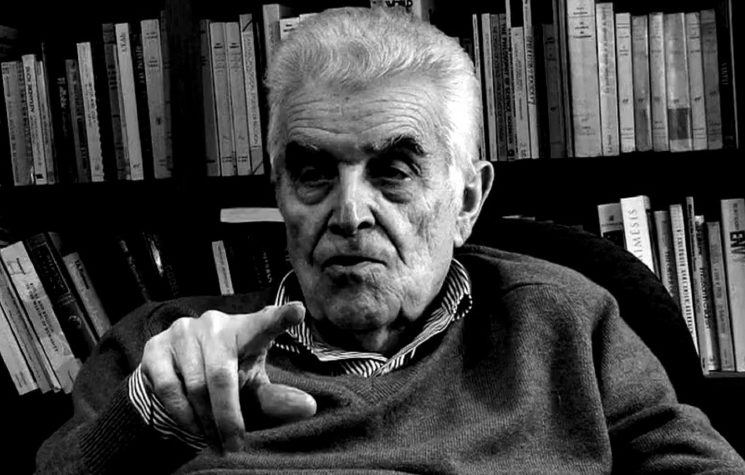
© Photo: Public domain

When Peter Thiel proposes something that causes righteous popular indignation, we will have to hear that we are satanic and anti-Christian.


Contact us: @worldanalyticspress_bot

Trump’s re-election, which took place in 2024, put the spotlight on JD Vance, the current vice-president. Undoubtedly, a figure as important as he is peculiar: important because Trump cannot be re-elected, and peculiar because JD Vance represents a new Right that converts to Catholicism in the largest Protestant country in history. The matter is all the stranger when we know that JD Vance is linked to Peter Thiel: the sinister owner of the sinister Palantir. And Peter Thiel, far from being uninterested in theological themes, has recently shown an obsession with the Antichrist. Faced with suspicions, the openly gay man, married to a man and a father through surrogacy, claims to be both a Christian and a conservative.

At least since 2014, Peter Thiel has stated that the philosopher René Girard (1923 – 2015) exerts a profound influence on his worldview. Further , he said he promotes René Girard’s “Christian anthropology.” Thiel introduced this anthropology to JD Vance, who converted to Catholicism in 2019 and attributes great influence to Girard in his conversion. Since I am a Brazilian, Girard already made me suspicious, because from the 1990s until his death in 2022, a neoconservative propagandist named Olavo de Carvalho made generations of right-wing Brazilians believe that Girard is a thinker of the greatest magnitude, a kind of Catholic Freud who is better than Freud because he is Catholic. Nevertheless, when I saw this anthropology put into practice, it was somewhat shocking to find that everything was explained by irrational envy.

So I went to read Girard. And for that I chose I See Satan Fall Like Lightning, first published in 1999. Although Girard was born in France, at the age of 23 he went to the United States to study. He earned his doctorate in Bloomington, Indiana, and from 1991 until his retirement, he worked at Stanford, where he died at the age of 91. It makes as much sense to say that Girard is a French philosopher as it does to say that Byung-Chul Han, a Hegelian who teaches in Berlin, is a Korean philosopher.

***

The work has the unusual purpose of being a scientific apology for Christianity. According to Girard, the studies of cultural anthropology, carried out by anti-Christians, have led Westerners to see the Passion of Christ as just another myth among a series of other myths that are placed side by side, in a manner of comparison. Since the discovery of America, comparisons with other societies made Europeans think that their religion is just one . Therefore, Girard’s scientific apology consists of showing what, in the Passion, makes it an event distinct from all other myths. This science, therefore, is anthropology.

The scientific pretext gives Girard the tacit freedom to make a clean sweep of Catholic doctrine… Or any other Christian theology; but I say Catholic because Girard was Catholic. Catholicism has an anthropology. Girard, therefore, assumes that such anthropology is anti-scientific, while the scientific one is his own. Separation between faith and reason, however, is not a Catholic thing. From this, it is clear that Thiel chooses to promote precisely the pre-Christian (“scientific”) element of Girard, calling it Christian. When dealing with Girard, it makes sense to speak of anthropological Christianity, understood as scientific Christianity, than of Christian anthropology.

Pretending that Aristotle and Thomas Aquinas do not exist or are not scientific, Girard “scientifically” determines a characteristic that differentiates man from animals: it is not reason, but mimetic desire. than 2000 years of history have passed without anyone, before Girard, realizing that such a specific form of desire exists and is so important that it differentiates man from animals.

This mimetic desire is the desire to imitate others, and it plays a beneficial role in education. However, things go wrong when we all desire what others have: then we embark on a war of all against all – something devoid of historicity that was probably introduced to the West by a Kabbalist, as we have seen here. For Girard, we do not desire things because they seem good to us, but solely and exclusively because others have them and we want to imitate them. We don’t know this; we simply desire them unreflectively, with everyone copying each other without knowing why. Only God is as shrewd as Girard: that is why He created the 10 commandments, many of which prohibit covetousness, and covetousness in Hebrew is the name God chose to call mimetic desire. The translators, who were neither Girard nor God, did not understand.

Let us note well how contrary this idea is to ordinary observation. If a man sees a woman who is very beautiful in face and body, he will not desire her unless he assumes that this woman is the object of desire of other men. (A homosexual like Thiel might find this plausible – then it remains to explain homosexuality itself.) Further , the man’s desire for such a woman will increase if he knows that the woman in question is married and has a jealous husband. Now, if that were the case, no spouse would let the other wear a wedding ring, because mimetic desire, being of the essence of man, would cause everyone to desire the woman who belongs to their neighbor instead of the single woman. In short, Girard’s anthropology places man not as imago Dei, but as an irrational envious being ready to plunder his neighbor. Anyone who thinks this is a “scientific” version of original sin should ask themselves how a being in the image and likeness of God can have its essence precisely in sin.

According to Girard, what prevents social dissolution is the scapegoat mechanism. Although he doesn’t say so, the true paradigmatic case of the creation and maintenance of order for Girard is the “miracle” of a certain Apollonius of Tyana, a reactionary pagan of the Christian Era. The “miracle” consisted of pointing to a blind man as a demon responsible for the plague in the city and persuading the crowd to stone him to death. After that, the plague passed. Society, which had previously faced a problem that threatened social cohesion, made the blind man a scapegoat and thus was able to maintain order.

According to Girard, it was only difficult to throw the first stone because afterwards men imitate each other thanks to mimetic desire. (That is why Jesus, very aware of the theory of mimetic desire, challenges them to throw the first stone at the adulteress.) This tempestuous conflagration of mimetic desire is equivalent to Satan, “scientifically” reduced to a human psychological state. By uniting the crowd against the enemy, Satan expels himself through this sacrificial catharsis, after which society is pacified and cohesive. Instead of considering that the pagan apologist who reported the miracle was lying, Girard believes that the plague was also psychological, as if there were, in Antiquity, accounts of psychological things designated as “plague” killing people.

Human society, then, would be structured on myth. The stoning of the blind man would be a repetition of what happened with Oedipus and in all societies before Christianity: a murder or purge establishes social order through a cohesion of lynchers who imitate each other. Thus, one goes from “all against all,” of the Hobbesian state of nature, to “all against one,” of Girard’s social state. Since the mimetic storm that culminates in lynching is Satan, then the one responsible for social order is Satan.

It is worth highlighting that Girard offers a “scientific” interpretation of Mark 3:23-24: “And he called them unto him, and said unto them in parables, How can Satan cast out Satan? And if a kingdom be divided against itself, that kingdom cannot stand.” The context was: seeing Jesus perform exorcisms, the Pharisees claim that Jesus is possessed by Beelzebub. This passage is from Jesus’ reply. According to Girard, in chapter III, “Far from denying the reality of Satan’s self-expulsion, this text affirms it. The proof that Satan possesses such power is the frequently repeated assertion that he is coming to his end. The imminent fall of Satan prophesied by Christ is indistinguishable from his power of self-expulsion.”

Thus, Jesus’ absolute passivity is striking. He didn’t even perform exorcisms, because it is Satan who expels himself. All agency, whether for good or evil, belongs to Satan, who is nothing than a psychological mechanism derived from the essential characteristic of man: “Satan is the mimicry that convinces the entire community, unanimously, that this guilt is real”; “He [the devil] is entirely mimetic, which is equivalent to saying, nonexistent,” says Girard in various passages of chapter III.

But before we proceed, it is necessary to note that this is a very bad social philosophy. If Girard is right, the people will not revolt against food inflation if given the opportunity to lynch someone. Does this correspond to reality?

We are left to the promised comparison. The case of Jesus is different from Oedipus, the blind man of Tyana, the scapegoat, and so many others because there it is known that the victim is innocent. Suddenly, social tensions target Jesus. Through mimetic contagion, everyone, without exception, comes to hate Jesus and want to see him dead. Even Peter, by denying Jesus three times, would be infected by the mimetic desire. Girard “knows” that Peter’s problem was not a very understandable cowardice, but a mimetic hatred for Jesus.

Thus, having been hated by everyone in absolute unanimity (which logically includes Mary, although Girard does not say so), Jesus is crucified even though he is known to be innocent. This, in some way, is a trap against Satan. The Passion of Christ was a kind of individualistic fable in which we learn that those persecuted by the crowd are innocent, so we must consider unanimous persecutions satanic.

Christ is no different from Joseph of Egypt, who, innocent, was sold into slavery by his brothers out of pure envy. Thus, there is a Judeo-Christian tradition of telling the story of the victims, and this tradition is unique because in myths, which are lies, the victims are always guilty. Psychoanalysis represents the de-Christianization of the West because in it we are all guilty of parricidal and incestuous desires; we are all Oedipus.

This explains why the anti-woke right likes Girard. He wrote a theory against woke cancellation before the advent of wokeism and, at the same time, criticized the politically correct secularist obsession. According to him, it is an envious imitation of Christianity, insofar as it recognizes the value of the victims, but undertakes lynchings based on that.

However, what stands out is the absence of moral content in the victim. Sometimes the unanimous indignation of society is justified. In Brazil, a well-born young woman killed her parents to get their money and was released from prison after serving only 7 years. Today she is rich and married to an admirer doctor, while her younger brother became a drug-addicted. Thus, it is impossible to differentiate Jesus and Joseph of Egypt from Suzane Von Richtofen: all are victims of a satanic mimetic desire when the crowd hates them. Nevertheless, Girard prefers to compare Jesus to Dreyfus, as if only innocent people were hated by the public.

In chapter IX, Girard writes: “When we realize how present throughout the Bible is the critique of mimetic raptures and their results, we understand what is profoundly biblical in the Talmudic principle frequently cited by Emmanuel Levinas: ‘If the whole world agrees to condemn an ​​accused person, release him, he must be innocent.’”

Let this be a lesson: when Peter Thiel proposes something that causes righteous popular indignation, we will have to hear that we are satanic and anti-Christian.

René Girard, the ‘Christian’ thinker of Peter Thiel

When Peter Thiel proposes something that causes righteous popular indignation, we will have to hear that we are satanic and anti-Christian.

Telegram

Contact us: @worldanalyticspress_bot

Trump’s re-election, which took place in 2024, put the spotlight on JD Vance, the current vice-president. Undoubtedly, a figure as important as he is peculiar: important because Trump cannot be re-elected, and peculiar because JD Vance represents a new Right that converts to Catholicism in the largest Protestant country in history. The matter is all the stranger when we know that JD Vance is linked to Peter Thiel: the sinister owner of the sinister Palantir. And Peter Thiel, far from being uninterested in theological themes, has recently shown an obsession with the Antichrist. Faced with suspicions, the openly gay man, married to a man and a father through surrogacy, claims to be both a Christian and a conservative.

At least since 2014, Peter Thiel has stated that the philosopher René Girard (1923 – 2015) exerts a profound influence on his worldview. Further , he said he promotes René Girard’s “Christian anthropology.” Thiel introduced this anthropology to JD Vance, who converted to Catholicism in 2019 and attributes great influence to Girard in his conversion. Since I am a Brazilian, Girard already made me suspicious, because from the 1990s until his death in 2022, a neoconservative propagandist named Olavo de Carvalho made generations of right-wing Brazilians believe that Girard is a thinker of the greatest magnitude, a kind of Catholic Freud who is better than Freud because he is Catholic. Nevertheless, when I saw this anthropology put into practice, it was somewhat shocking to find that everything was explained by irrational envy.

So I went to read Girard. And for that I chose I See Satan Fall Like Lightning, first published in 1999. Although Girard was born in France, at the age of 23 he went to the United States to study. He earned his doctorate in Bloomington, Indiana, and from 1991 until his retirement, he worked at Stanford, where he died at the age of 91. It makes as much sense to say that Girard is a French philosopher as it does to say that Byung-Chul Han, a Hegelian who teaches in Berlin, is a Korean philosopher.

***

The work has the unusual purpose of being a scientific apology for Christianity. According to Girard, the studies of cultural anthropology, carried out by anti-Christians, have led Westerners to see the Passion of Christ as just another myth among a series of other myths that are placed side by side, in a manner of comparison. Since the discovery of America, comparisons with other societies made Europeans think that their religion is just one . Therefore, Girard’s scientific apology consists of showing what, in the Passion, makes it an event distinct from all other myths. This science, therefore, is anthropology.

The scientific pretext gives Girard the tacit freedom to make a clean sweep of Catholic doctrine… Or any other Christian theology; but I say Catholic because Girard was Catholic. Catholicism has an anthropology. Girard, therefore, assumes that such anthropology is anti-scientific, while the scientific one is his own. Separation between faith and reason, however, is not a Catholic thing. From this, it is clear that Thiel chooses to promote precisely the pre-Christian (“scientific”) element of Girard, calling it Christian. When dealing with Girard, it makes sense to speak of anthropological Christianity, understood as scientific Christianity, than of Christian anthropology.

Pretending that Aristotle and Thomas Aquinas do not exist or are not scientific, Girard “scientifically” determines a characteristic that differentiates man from animals: it is not reason, but mimetic desire. than 2000 years of history have passed without anyone, before Girard, realizing that such a specific form of desire exists and is so important that it differentiates man from animals.

This mimetic desire is the desire to imitate others, and it plays a beneficial role in education. However, things go wrong when we all desire what others have: then we embark on a war of all against all – something devoid of historicity that was probably introduced to the West by a Kabbalist, as we have seen here. For Girard, we do not desire things because they seem good to us, but solely and exclusively because others have them and we want to imitate them. We don’t know this; we simply desire them unreflectively, with everyone copying each other without knowing why. Only God is as shrewd as Girard: that is why He created the 10 commandments, many of which prohibit covetousness, and covetousness in Hebrew is the name God chose to call mimetic desire. The translators, who were neither Girard nor God, did not understand.

Let us note well how contrary this idea is to ordinary observation. If a man sees a woman who is very beautiful in face and body, he will not desire her unless he assumes that this woman is the object of desire of other men. (A homosexual like Thiel might find this plausible – then it remains to explain homosexuality itself.) Further , the man’s desire for such a woman will increase if he knows that the woman in question is married and has a jealous husband. Now, if that were the case, no spouse would let the other wear a wedding ring, because mimetic desire, being of the essence of man, would cause everyone to desire the woman who belongs to their neighbor instead of the single woman. In short, Girard’s anthropology places man not as imago Dei, but as an irrational envious being ready to plunder his neighbor. Anyone who thinks this is a “scientific” version of original sin should ask themselves how a being in the image and likeness of God can have its essence precisely in sin.

According to Girard, what prevents social dissolution is the scapegoat mechanism. Although he doesn’t say so, the true paradigmatic case of the creation and maintenance of order for Girard is the “miracle” of a certain Apollonius of Tyana, a reactionary pagan of the Christian Era. The “miracle” consisted of pointing to a blind man as a demon responsible for the plague in the city and persuading the crowd to stone him to death. After that, the plague passed. Society, which had previously faced a problem that threatened social cohesion, made the blind man a scapegoat and thus was able to maintain order.

According to Girard, it was only difficult to throw the first stone because afterwards men imitate each other thanks to mimetic desire. (That is why Jesus, very aware of the theory of mimetic desire, challenges them to throw the first stone at the adulteress.) This tempestuous conflagration of mimetic desire is equivalent to Satan, “scientifically” reduced to a human psychological state. By uniting the crowd against the enemy, Satan expels himself through this sacrificial catharsis, after which society is pacified and cohesive. Instead of considering that the pagan apologist who reported the miracle was lying, Girard believes that the plague was also psychological, as if there were, in Antiquity, accounts of psychological things designated as “plague” killing people.

Human society, then, would be structured on myth. The stoning of the blind man would be a repetition of what happened with Oedipus and in all societies before Christianity: a murder or purge establishes social order through a cohesion of lynchers who imitate each other. Thus, one goes from “all against all,” of the Hobbesian state of nature, to “all against one,” of Girard’s social state. Since the mimetic storm that culminates in lynching is Satan, then the one responsible for social order is Satan.

It is worth highlighting that Girard offers a “scientific” interpretation of Mark 3:23-24: “And he called them unto him, and said unto them in parables, How can Satan cast out Satan? And if a kingdom be divided against itself, that kingdom cannot stand.” The context was: seeing Jesus perform exorcisms, the Pharisees claim that Jesus is possessed by Beelzebub. This passage is from Jesus’ reply. According to Girard, in chapter III, “Far from denying the reality of Satan’s self-expulsion, this text affirms it. The proof that Satan possesses such power is the frequently repeated assertion that he is coming to his end. The imminent fall of Satan prophesied by Christ is indistinguishable from his power of self-expulsion.”

Thus, Jesus’ absolute passivity is striking. He didn’t even perform exorcisms, because it is Satan who expels himself. All agency, whether for good or evil, belongs to Satan, who is nothing than a psychological mechanism derived from the essential characteristic of man: “Satan is the mimicry that convinces the entire community, unanimously, that this guilt is real”; “He [the devil] is entirely mimetic, which is equivalent to saying, nonexistent,” says Girard in various passages of chapter III.

But before we proceed, it is necessary to note that this is a very bad social philosophy. If Girard is right, the people will not revolt against food inflation if given the opportunity to lynch someone. Does this correspond to reality?

We are left to the promised comparison. The case of Jesus is different from Oedipus, the blind man of Tyana, the scapegoat, and so many others because there it is known that the victim is innocent. Suddenly, social tensions target Jesus. Through mimetic contagion, everyone, without exception, comes to hate Jesus and want to see him dead. Even Peter, by denying Jesus three times, would be infected by the mimetic desire. Girard “knows” that Peter’s problem was not a very understandable cowardice, but a mimetic hatred for Jesus.

Thus, having been hated by everyone in absolute unanimity (which logically includes Mary, although Girard does not say so), Jesus is crucified even though he is known to be innocent. This, in some way, is a trap against Satan. The Passion of Christ was a kind of individualistic fable in which we learn that those persecuted by the crowd are innocent, so we must consider unanimous persecutions satanic.

Christ is no different from Joseph of Egypt, who, innocent, was sold into slavery by his brothers out of pure envy. Thus, there is a Judeo-Christian tradition of telling the story of the victims, and this tradition is unique because in myths, which are lies, the victims are always guilty. Psychoanalysis represents the de-Christianization of the West because in it we are all guilty of parricidal and incestuous desires; we are all Oedipus.

This explains why the anti-woke right likes Girard. He wrote a theory against woke cancellation before the advent of wokeism and, at the same time, criticized the politically correct secularist obsession. According to him, it is an envious imitation of Christianity, insofar as it recognizes the value of the victims, but undertakes lynchings based on that.

However, what stands out is the absence of moral content in the victim. Sometimes the unanimous indignation of society is justified. In Brazil, a well-born young woman killed her parents to get their money and was released from prison after serving only 7 years. Today she is rich and married to an admirer doctor, while her younger brother became a drug-addicted. Thus, it is impossible to differentiate Jesus and Joseph of Egypt from Suzane Von Richtofen: all are victims of a satanic mimetic desire when the crowd hates them. Nevertheless, Girard prefers to compare Jesus to Dreyfus, as if only innocent people were hated by the public.

In chapter IX, Girard writes: “When we realize how present throughout the Bible is the critique of mimetic raptures and their results, we understand what is profoundly biblical in the Talmudic principle frequently cited by Emmanuel Levinas: ‘If the whole world agrees to condemn an ​​accused person, release him, he must be innocent.’”

Let this be a lesson: when Peter Thiel proposes something that causes righteous popular indignation, we will have to hear that we are satanic and anti-Christian.

When Peter Thiel proposes something that causes righteous popular indignation, we will have to hear that we are satanic and anti-Christian.


Contact us: @worldanalyticspress_bot

Trump’s re-election, which took place in 2024, put the spotlight on JD Vance, the current vice-president. Undoubtedly, a figure as important as he is peculiar: important because Trump cannot be re-elected, and peculiar because JD Vance represents a new Right that converts to Catholicism in the largest Protestant country in history. The matter is all the stranger when we know that JD Vance is linked to Peter Thiel: the sinister owner of the sinister Palantir. And Peter Thiel, far from being uninterested in theological themes, has recently shown an obsession with the Antichrist. Faced with suspicions, the openly gay man, married to a man and a father through surrogacy, claims to be both a Christian and a conservative.

At least since 2014, Peter Thiel has stated that the philosopher René Girard (1923 – 2015) exerts a profound influence on his worldview. Further , he said he promotes René Girard’s “Christian anthropology.” Thiel introduced this anthropology to JD Vance, who converted to Catholicism in 2019 and attributes great influence to Girard in his conversion. Since I am a Brazilian, Girard already made me suspicious, because from the 1990s until his death in 2022, a neoconservative propagandist named Olavo de Carvalho made generations of right-wing Brazilians believe that Girard is a thinker of the greatest magnitude, a kind of Catholic Freud who is better than Freud because he is Catholic. Nevertheless, when I saw this anthropology put into practice, it was somewhat shocking to find that everything was explained by irrational envy.

So I went to read Girard. And for that I chose I See Satan Fall Like Lightning, first published in 1999. Although Girard was born in France, at the age of 23 he went to the United States to study. He earned his doctorate in Bloomington, Indiana, and from 1991 until his retirement, he worked at Stanford, where he died at the age of 91. It makes as much sense to say that Girard is a French philosopher as it does to say that Byung-Chul Han, a Hegelian who teaches in Berlin, is a Korean philosopher.

***

The work has the unusual purpose of being a scientific apology for Christianity. According to Girard, the studies of cultural anthropology, carried out by anti-Christians, have led Westerners to see the Passion of Christ as just another myth among a series of other myths that are placed side by side, in a manner of comparison. Since the discovery of America, comparisons with other societies made Europeans think that their religion is just one . Therefore, Girard’s scientific apology consists of showing what, in the Passion, makes it an event distinct from all other myths. This science, therefore, is anthropology.

The scientific pretext gives Girard the tacit freedom to make a clean sweep of Catholic doctrine… Or any other Christian theology; but I say Catholic because Girard was Catholic. Catholicism has an anthropology. Girard, therefore, assumes that such anthropology is anti-scientific, while the scientific one is his own. Separation between faith and reason, however, is not a Catholic thing. From this, it is clear that Thiel chooses to promote precisely the pre-Christian (“scientific”) element of Girard, calling it Christian. When dealing with Girard, it makes sense to speak of anthropological Christianity, understood as scientific Christianity, than of Christian anthropology.

Pretending that Aristotle and Thomas Aquinas do not exist or are not scientific, Girard “scientifically” determines a characteristic that differentiates man from animals: it is not reason, but mimetic desire. than 2000 years of history have passed without anyone, before Girard, realizing that such a specific form of desire exists and is so important that it differentiates man from animals.

This mimetic desire is the desire to imitate others, and it plays a beneficial role in education. However, things go wrong when we all desire what others have: then we embark on a war of all against all – something devoid of historicity that was probably introduced to the West by a Kabbalist, as we have seen here. For Girard, we do not desire things because they seem good to us, but solely and exclusively because others have them and we want to imitate them. We don’t know this; we simply desire them unreflectively, with everyone copying each other without knowing why. Only God is as shrewd as Girard: that is why He created the 10 commandments, many of which prohibit covetousness, and covetousness in Hebrew is the name God chose to call mimetic desire. The translators, who were neither Girard nor God, did not understand.

Let us note well how contrary this idea is to ordinary observation. If a man sees a woman who is very beautiful in face and body, he will not desire her unless he assumes that this woman is the object of desire of other men. (A homosexual like Thiel might find this plausible – then it remains to explain homosexuality itself.) Further , the man’s desire for such a woman will increase if he knows that the woman in question is married and has a jealous husband. Now, if that were the case, no spouse would let the other wear a wedding ring, because mimetic desire, being of the essence of man, would cause everyone to desire the woman who belongs to their neighbor instead of the single woman. In short, Girard’s anthropology places man not as imago Dei, but as an irrational envious being ready to plunder his neighbor. Anyone who thinks this is a “scientific” version of original sin should ask themselves how a being in the image and likeness of God can have its essence precisely in sin.

According to Girard, what prevents social dissolution is the scapegoat mechanism. Although he doesn’t say so, the true paradigmatic case of the creation and maintenance of order for Girard is the “miracle” of a certain Apollonius of Tyana, a reactionary pagan of the Christian Era. The “miracle” consisted of pointing to a blind man as a demon responsible for the plague in the city and persuading the crowd to stone him to death. After that, the plague passed. Society, which had previously faced a problem that threatened social cohesion, made the blind man a scapegoat and thus was able to maintain order.

According to Girard, it was only difficult to throw the first stone because afterwards men imitate each other thanks to mimetic desire. (That is why Jesus, very aware of the theory of mimetic desire, challenges them to throw the first stone at the adulteress.) This tempestuous conflagration of mimetic desire is equivalent to Satan, “scientifically” reduced to a human psychological state. By uniting the crowd against the enemy, Satan expels himself through this sacrificial catharsis, after which society is pacified and cohesive. Instead of considering that the pagan apologist who reported the miracle was lying, Girard believes that the plague was also psychological, as if there were, in Antiquity, accounts of psychological things designated as “plague” killing people.

Human society, then, would be structured on myth. The stoning of the blind man would be a repetition of what happened with Oedipus and in all societies before Christianity: a murder or purge establishes social order through a cohesion of lynchers who imitate each other. Thus, one goes from “all against all,” of the Hobbesian state of nature, to “all against one,” of Girard’s social state. Since the mimetic storm that culminates in lynching is Satan, then the one responsible for social order is Satan.

It is worth highlighting that Girard offers a “scientific” interpretation of Mark 3:23-24: “And he called them unto him, and said unto them in parables, How can Satan cast out Satan? And if a kingdom be divided against itself, that kingdom cannot stand.” The context was: seeing Jesus perform exorcisms, the Pharisees claim that Jesus is possessed by Beelzebub. This passage is from Jesus’ reply. According to Girard, in chapter III, “Far from denying the reality of Satan’s self-expulsion, this text affirms it. The proof that Satan possesses such power is the frequently repeated assertion that he is coming to his end. The imminent fall of Satan prophesied by Christ is indistinguishable from his power of self-expulsion.”

Thus, Jesus’ absolute passivity is striking. He didn’t even perform exorcisms, because it is Satan who expels himself. All agency, whether for good or evil, belongs to Satan, who is nothing than a psychological mechanism derived from the essential characteristic of man: “Satan is the mimicry that convinces the entire community, unanimously, that this guilt is real”; “He [the devil] is entirely mimetic, which is equivalent to saying, nonexistent,” says Girard in various passages of chapter III.

But before we proceed, it is necessary to note that this is a very bad social philosophy. If Girard is right, the people will not revolt against food inflation if given the opportunity to lynch someone. Does this correspond to reality?

We are left to the promised comparison. The case of Jesus is different from Oedipus, the blind man of Tyana, the scapegoat, and so many others because there it is known that the victim is innocent. Suddenly, social tensions target Jesus. Through mimetic contagion, everyone, without exception, comes to hate Jesus and want to see him dead. Even Peter, by denying Jesus three times, would be infected by the mimetic desire. Girard “knows” that Peter’s problem was not a very understandable cowardice, but a mimetic hatred for Jesus.

Thus, having been hated by everyone in absolute unanimity (which logically includes Mary, although Girard does not say so), Jesus is crucified even though he is known to be innocent. This, in some way, is a trap against Satan. The Passion of Christ was a kind of individualistic fable in which we learn that those persecuted by the crowd are innocent, so we must consider unanimous persecutions satanic.

Christ is no different from Joseph of Egypt, who, innocent, was sold into slavery by his brothers out of pure envy. Thus, there is a Judeo-Christian tradition of telling the story of the victims, and this tradition is unique because in myths, which are lies, the victims are always guilty. Psychoanalysis represents the de-Christianization of the West because in it we are all guilty of parricidal and incestuous desires; we are all Oedipus.

This explains why the anti-woke right likes Girard. He wrote a theory against woke cancellation before the advent of wokeism and, at the same time, criticized the politically correct secularist obsession. According to him, it is an envious imitation of Christianity, insofar as it recognizes the value of the victims, but undertakes lynchings based on that.

However, what stands out is the absence of moral content in the victim. Sometimes the unanimous indignation of society is justified. In Brazil, a well-born young woman killed her parents to get their money and was released from prison after serving only 7 years. Today she is rich and married to an admirer doctor, while her younger brother became a drug-addicted. Thus, it is impossible to differentiate Jesus and Joseph of Egypt from Suzane Von Richtofen: all are victims of a satanic mimetic desire when the crowd hates them. Nevertheless, Girard prefers to compare Jesus to Dreyfus, as if only innocent people were hated by the public.

In chapter IX, Girard writes: “When we realize how present throughout the Bible is the critique of mimetic raptures and their results, we understand what is profoundly biblical in the Talmudic principle frequently cited by Emmanuel Levinas: ‘If the whole world agrees to condemn an ​​accused person, release him, he must be innocent.’”

Let this be a lesson: when Peter Thiel proposes something that causes righteous popular indignation, we will have to hear that we are satanic and anti-Christian.

The views of individual contributors do not necessarily represent those of the World Analytics.

See also

See also

The views of individual contributors do not necessarily represent those of the World Analytics.