Editor's Сhoice
February 19, 2026
© Photo: Public domain

By Stefan MOORE

Join us on  

Contact us: @worldanalyticspress_bot

Amid the largest genocide of this century in Gaza and the violent ethnic cleansing on the West Bank, two prominent Jewish historians believe that one democratic secular state in Palestine is not only achievable but inevitable, writes Stefan Moore.

Two prominent Jewish historians have recently written from different perspectives — one economic and political; one largely theological and moral — that the state of Israel is doomed and living on borrowed time.

Despite coming in the midst of the largest genocide of this century in Gaza and the violent ethnic cleansing on the West Bank, they believe that one democratic secular state in Palestine is not only achievable but inevitable.

In his latest book, Israel on the Brink: Eight Steps for a Better Future, llan Pappé writes that Israel is self-destructing economically, militarily and politically as it finds itself abandoned internationally.

According to Pappé, the farcical two-state solution is “a rotting corpse” and the only way forward is decolonisation, the return of Palestinian refugees to their land, accountability for those who have committed crimes and a new model of statehood for Palestine and the region.

A corollary to Pappé is the moral and religious critique of Zionism by Canadian Jewish historian and biblical scholar Yakov Rabkin who holds that the Zionist movement is a death trap for Jews, the region and the world.

In his recent book, Israel in Palestine: Jewish Rejection of Zionism and his earlier work, What is Modern Israel, Rabkin relates how the Jewish state represents a complete repudiation of the most fundamental values of Judaism.

In Israel, he says, values such as tolerance, morality and humility have been replaced with a new muscular Jewish identity that extols nationalism, aggression, violence and conquest. Traditional Jewish culture is looked upon with contempt.

Rabkin recounts how Zionist leader Vladimir Jabotinsky, the founder of the terrorist Jewish militia Irgun, described transforming the “Yid” from the shtetels of Eastern Europe into the New Hebrew:

“Our starting point is to take the typical Yid of today and to imagine a diametrical opposite…because the Yid is ugly, sickly, and lacks decorum, we shall endow the ideal image of the Hebrew with masculine beauty. The Yid is trodden upon and easily frightened and, therefore, the Hebrew ought to be proud and independent. … The Yid has accepted submission and, therefore, the Hebrew ought to learn how to command.”

If you hear echoes of Nazi master race philosophy, it’s no accident. Jabotinsky is channeling the views of early Zionist eugenicists such as Arthur Ruppin who sought “the purification of the [Jewish] race” and “maintained his ties with the German theoreticians of racial science even after the National Socialist regime took power.”

As for the Jewish religion, Rabkin dismantles the Zionist myth that the land of Israel was a God-given promise to the Jews – a claim “based on a literal interpretation of the bible that diverged drastically from the teachings of Rabbinical Judaism.”

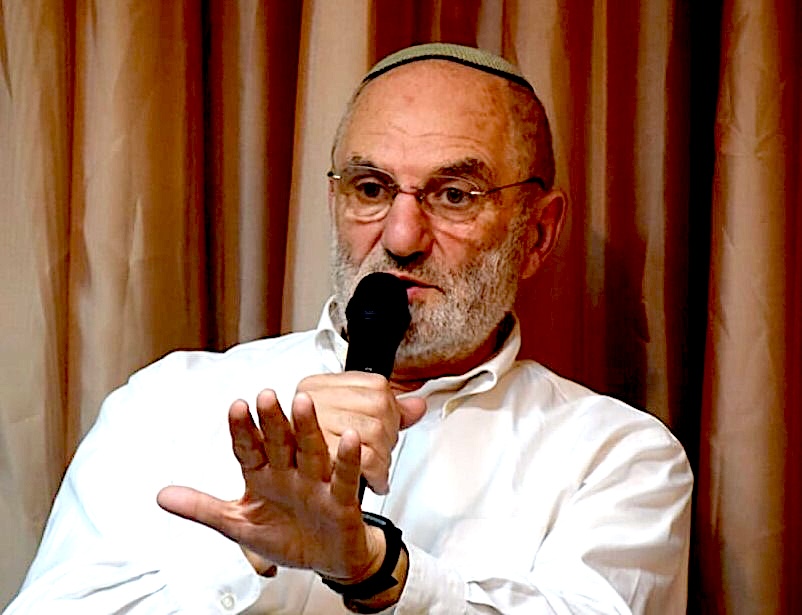
Yakov M. Rabkin, 2017. (Alexandr Shcherba /Wikimedia Commons/ CC BY-SA 4.0)

To begin with, he explains, Palestine was never a homeland for Jews who, in fact, came from Mesopotamia and Egypt and migrated to Canaan (Palestine).  There, according to the Talmud (the foundational source of Jewish theology) Abraham and his descendants were instructed by God to disperse to the four corners of the earth and never to return “en masse and in force” to the land of Israel until they had become spiritually purified.

In other words, until the coming of the messiah, Jews should stay where they are, which, in fact, is exactly where they have been.

Ashkenazi Jews have lived in Europe since Roman times and had been thoroughly assimilated into European culture.  In the 19th century, many were socialists, communists and members of the Jewish Labour Bund which emphasized the right to thrive in their own culture, speak their own language (Yiddish) and fight for justice in the countries they inhabited, Rabkin says.

As a result, when Zionism emerged as a movement at the end of the 19th century, most Jews viewed it as a reactionary cult and a bourgeois adventure opposed to the interest of the Jewish working class, the author argues.

But some of the strongest opposition, Rabkin writes, came from religious Jews who believed Zionism is in direct conflict with the values of Judaism, which teaches that the Torah (the Jewish bible), and not a nation, is what binds Jews together. In the words of one Orthodox Jewish scholar, Zionism was “a spiritual corruption…that borders on blasphemy,” Rabkin says.

The opposition to Zionism, of course, was muted with the Holocaust — a genocide that Zionists immediately seized upon as an opportunity for nation building in Israel.  Not only did Zionists actively thwart Jews from emigrating to other countries during and after the war, they used the Holocaust as a lever to bolster the Jewish population in Palestine, argues Rabkin.

In fact, Nazi anti-Semites and Zionists became joined at the hip. “The anti-Semites wished to be rid of the Jews, the Zionists sought to gather the Jews in the Holy Land,” writes Rabkin.

Leopold von Mildenstein in Palestine in 1933. (Wikimedia Commons/ Public Domain)

In 1933, Rabkin recounts, the high-ranking Nazi SS officer Baron Leopold Elder von Mildenstein travelled to Palestine with his good friend German Zionist Federation leader Kurt Tuchler. After his return, Mildenstein wrote laudatory articles about the Zionist enterprise and a special medal was coined to commemorate his visit.  On one side was a Swastika, on the other, The Star of David.

Today, the Zionist ideology first espoused by Theodore Herzl in 1896 and transmitted through every Israeli leader from David Ben-Gurion, Menahem Begin, Ariel Sharon and onward has morphed into the most right-wing, militant and genocidal government in Israel to date.

The rabidly racist cabinet ministers Bezalel Smotrich and Itamar Ben Gvir are now followers of a new messianic movement called National Judaism – what Rabkin describes as “the dominant ideology of vigilante settlers who have harassed, dispossessed and murdered Palestinians in the West Bank and encourage the starvation of Palestinians in Gaza.”

“Since its inception in the late 19th century, critics of Zionism warned that the Zionist state would become a death trap, endangering both the colonisers and the colonised alike,” writes Rabkin. “For those voices…the Zionist experiment was seen as a tragic mistake [and] the sooner it ended … the better for humanity as a whole.”

Concluding with his own reflection as an observant Jew he writes:

“Jewish teachings frequently attribute the root causes of communal suffering to internal moral failings. In this light, Israel’s current trajectory –- marked by impunity, hubris and cruelty, all of which contradict Jewish values –- appears destined for moral and political ruin.”

One Democratic, Multiethnic State

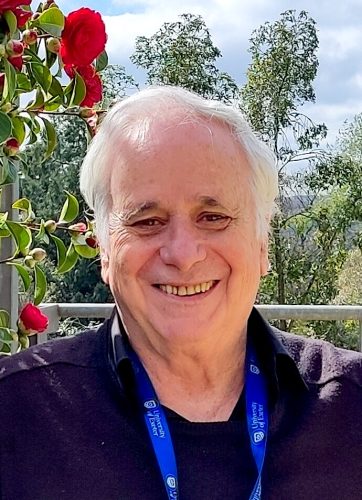
Ilan Pappe at the University of Exeter, April 2023. (Fjmustak/Wikimedia Commons/ CC BY-SA 4.0)

Pappé shares Rabkin’s view that Israel is in a suicidal spiral that will ultimately lead to its collapse. But, then, he takes a giant leap into the future to look at what he envisions emerging from the ruins – one democratic, multiethnic state in Palestine.

Israel on the Brink starts with the disastrous events from the time of the 1917 Balfour Declaration and the founding of the Israeli state in 1948 to the rise of the religious right settler movement in recent years.

Like a building engineer surveying a crumbling structure, Pappé points out the fatal cracks in the foundations of the Israeli state that will ultimately widen and lead to the collapse of the Zionist project – an event that he believes “could well change the course of world history in this century.”

Crack No. 1 — a very big one, according to Pappé — is the rise of messianic Zionism — the belief the Holy Land was given to the Jewish people by God to hasten redemption. Pioneered by Rabbi Avraham Yitzchak Kook (1865-1935) it was

“the most extreme form of Zionism: a fusion of messianic ideas with unashamed racism towards the Palestinians and contempt for secular and Reform Judaism.”

Kook’s disciples form a direct line from his son, Tzvi Yehuda HaKohen Kook to today’s far-right West Bank settlers and the dominant political coalition including ministers Itamar Ben Gvir and Bezalel Smotrich.

This movement, writes Pappé, represents one of the most serious cracks in Israel’s unstable political foundations –- a schism between religious right and political Zionists that, ironically, despite their differences, shares the same goal of maintaining Jewish supremacy in Palestine.

Other foundational cracks exposed by Pappé are: the “unprecedented support for the Palestinian cause around the world,” deepening economic troubles as the wealth gap widens, investment dries up and the most affluent professionals flee the country (estimated to be over half a million since 2023).

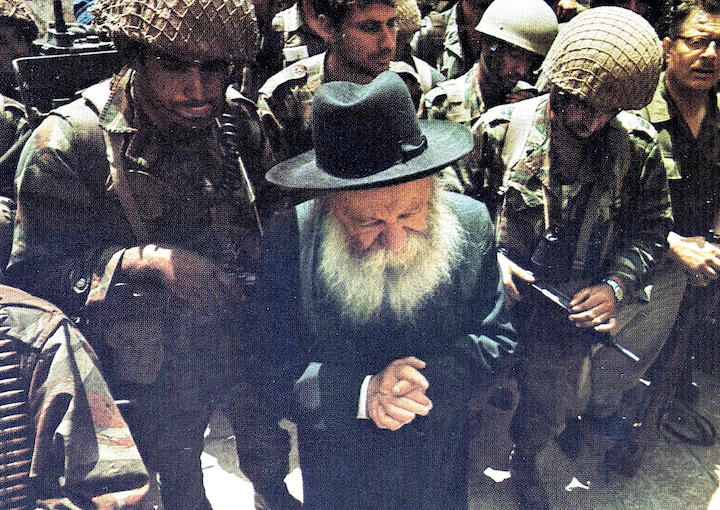
Rabbi Zvi Yehuda Kook with Israeli forces at the Western Wall shortly after Israeli forces captured it in 1967. (Wikimedia Commons/Public Domain)

Added to the list are the “glaring inadequacy” of the Israeli military that, while capable of bombing Gaza to rubble, is not trained for real combat and unable to defeat Hamas; and the crumbling civilian apparatus that is incapable of adequately housing the thousands of Israelis displaced by the wars in Gaza and Lebanon.

Finally, there’s the biggest crack of all – the rise of a new Palestinian Liberation Movement at the same time that the Zionist project “is careening towards a cliff edge.” This is a movement of energised young Palestinians who, “instead of pursuing a two-state solution, as the Palestinian Authority has done fruitlessly for several decades, … are seeking a genuine one-state solution.”

The challenge, according to Pappé, will be to meld youthful fervour with a clear political agenda. “Every successful revolution in history arrived when the creative energy of the masses met the programmatic vision of a confident organisation that could voice their demands,” he writes, “what Leon Trotsky described as ‘the inspired frenzy of history.’”

The guiding principle at the centre of this revolution is justice —transitional justice which involves legally addressing systemic human rights violations and holding the guilty accountable and restorative justice to provide restitution to their victims, Pappé says .

First and foremost, this means giving the 6 million Palestinian refugees who were driven off their land since 1948 the right of return to their towns and villages.

Next, is the dismantling of Jewish settlements in the West Bank and East Jerusalem. Isolated outposts occupied by fanatical settlers will require total demolition but the sprawling urban settlements built since 1967 will present bigger challenges.

In any case,

“transitional justice will involve deconstructing the legal framework of the apartheid state and supplanting it with one that does not discriminate between Jews and non-Jews in property ownership, urban planning and land use.”

But perhaps Pappé’s most sweeping vision of all is reconnecting Palestine with the entire Eastern Mediterranean, the Mashreq, “which were organically linked to each other by cultural, social, economic, historical and ideological ties dating back centuries.”

This entire region, where Muslims, Christians and Jews lived together in relative harmony for thousands of years before the European colonial powers carved it up with artificial boundaries, could be reconnected with Palestine inspiring “a wider revolution in all the Mashreq.”

In regard to the millions of Jews who will remain living in post-Israel Palestine, Pappé believes they will be willing to contribute to the building of this new future: “The way other Jewish communities elsewhere in the world view themselves as part of their respective countries can be replicated in post-Israel Palestine.”

Envisioning a Future

Gaza solidarity demonstration in Berlin on Nov. 4, 2023, organized by Palestinian and Jewish groups. (Streets of Berlin – Free Palestine will not be cancelled/Wikimedia Commons/ CC BY-SA 2.0)

Israel on the Brink concludes by conjuring up a post-Israel Palestine in the form of a fictional diary where Pappé is both observer and participant in the building of a future society — beginning in 2027 and culminating in 2048, 100 years after the founding of the Israeli State.

Over this time, he witnesses Israel becoming increasing isolated internationally; the nations of the world imposing crippling sanctions and cutting off diplomatic relations; the mass exodus of Israeli citizens; towns and streets being given back their Arab names; new political coalitions being formed between Palestinian and Jewish parties; fears that the capitalist model will leave power in the hands of an affluent Jewish and Palestinian elite creating a new form of apartheid; the creation of a new educational system and the recognition of returning Palestinian refugees as full citizens.

Is this just wishful thinking to imagine the brutal, racist stain of Zionism will be washed away in the foreseeable future and a new democratic state emerge in its place?

The roadblocks are formidable  –-  from the continued military occupation of Gaza under Trump’s Orwellian Board of Peace to the massive 82 percent support among Jewish Israelis for the ethnic cleansing of Gaza, making Israel what American political scientist Norman Finklestein calls “a whole society that has been effectively Nazified.”

Neither Ilan Pappé nor Yakov Rabkin are under illusions about the obstacles; they only believe that the creation of the State of Israel was a tragic historical mistake and, in the interest of the Palestinian people and all humanity, it must come to an end.

One way, as Palestinian author Ghada Kharmi has written is that, “The U.N. that made Israel must now unmake it, not by expulsion and displacement as in 1948, but by converting its bleak legacy into a future of hope for both peoples in one state.”

This would certainly be a first step on the road to the one-state solution that Pappé and Rabkin envision – one that we can only hope to see the beginnings of in our lifetime.

Original article:  consortiumnews.com
The views of individual contributors do not necessarily represent those of the World Analytics.
Israel on the brink

By Stefan MOORE

Join us on Telegram

Contact us: @worldanalyticspress_bot

Amid the largest genocide of this century in Gaza and the violent ethnic cleansing on the West Bank, two prominent Jewish historians believe that one democratic secular state in Palestine is not only achievable but inevitable, writes Stefan Moore.

Two prominent Jewish historians have recently written from different perspectives — one economic and political; one largely theological and moral — that the state of Israel is doomed and living on borrowed time.

Despite coming in the midst of the largest genocide of this century in Gaza and the violent ethnic cleansing on the West Bank, they believe that one democratic secular state in Palestine is not only achievable but inevitable.

In his latest book, Israel on the Brink: Eight Steps for a Better Future, llan Pappé writes that Israel is self-destructing economically, militarily and politically as it finds itself abandoned internationally.

According to Pappé, the farcical two-state solution is “a rotting corpse” and the only way forward is decolonisation, the return of Palestinian refugees to their land, accountability for those who have committed crimes and a new model of statehood for Palestine and the region.

A corollary to Pappé is the moral and religious critique of Zionism by Canadian Jewish historian and biblical scholar Yakov Rabkin who holds that the Zionist movement is a death trap for Jews, the region and the world.

In his recent book, Israel in Palestine: Jewish Rejection of Zionism and his earlier work, What is Modern Israel, Rabkin relates how the Jewish state represents a complete repudiation of the most fundamental values of Judaism.

In Israel, he says, values such as tolerance, morality and humility have been replaced with a new muscular Jewish identity that extols nationalism, aggression, violence and conquest. Traditional Jewish culture is looked upon with contempt.

Rabkin recounts how Zionist leader Vladimir Jabotinsky, the founder of the terrorist Jewish militia Irgun, described transforming the “Yid” from the shtetels of Eastern Europe into the New Hebrew:

“Our starting point is to take the typical Yid of today and to imagine a diametrical opposite…because the Yid is ugly, sickly, and lacks decorum, we shall endow the ideal image of the Hebrew with masculine beauty. The Yid is trodden upon and easily frightened and, therefore, the Hebrew ought to be proud and independent. … The Yid has accepted submission and, therefore, the Hebrew ought to learn how to command.”

If you hear echoes of Nazi master race philosophy, it’s no accident. Jabotinsky is channeling the views of early Zionist eugenicists such as Arthur Ruppin who sought “the purification of the [Jewish] race” and “maintained his ties with the German theoreticians of racial science even after the National Socialist regime took power.”

As for the Jewish religion, Rabkin dismantles the Zionist myth that the land of Israel was a God-given promise to the Jews – a claim “based on a literal interpretation of the bible that diverged drastically from the teachings of Rabbinical Judaism.”

Yakov M. Rabkin, 2017. (Alexandr Shcherba /Wikimedia Commons/ CC BY-SA 4.0)

To begin with, he explains, Palestine was never a homeland for Jews who, in fact, came from Mesopotamia and Egypt and migrated to Canaan (Palestine).  There, according to the Talmud (the foundational source of Jewish theology) Abraham and his descendants were instructed by God to disperse to the four corners of the earth and never to return “en masse and in force” to the land of Israel until they had become spiritually purified.

In other words, until the coming of the messiah, Jews should stay where they are, which, in fact, is exactly where they have been.

Ashkenazi Jews have lived in Europe since Roman times and had been thoroughly assimilated into European culture.  In the 19th century, many were socialists, communists and members of the Jewish Labour Bund which emphasized the right to thrive in their own culture, speak their own language (Yiddish) and fight for justice in the countries they inhabited, Rabkin says.

As a result, when Zionism emerged as a movement at the end of the 19th century, most Jews viewed it as a reactionary cult and a bourgeois adventure opposed to the interest of the Jewish working class, the author argues.

But some of the strongest opposition, Rabkin writes, came from religious Jews who believed Zionism is in direct conflict with the values of Judaism, which teaches that the Torah (the Jewish bible), and not a nation, is what binds Jews together. In the words of one Orthodox Jewish scholar, Zionism was “a spiritual corruption…that borders on blasphemy,” Rabkin says.

The opposition to Zionism, of course, was muted with the Holocaust — a genocide that Zionists immediately seized upon as an opportunity for nation building in Israel.  Not only did Zionists actively thwart Jews from emigrating to other countries during and after the war, they used the Holocaust as a lever to bolster the Jewish population in Palestine, argues Rabkin.

In fact, Nazi anti-Semites and Zionists became joined at the hip. “The anti-Semites wished to be rid of the Jews, the Zionists sought to gather the Jews in the Holy Land,” writes Rabkin.

Leopold von Mildenstein in Palestine in 1933. (Wikimedia Commons/ Public Domain)

In 1933, Rabkin recounts, the high-ranking Nazi SS officer Baron Leopold Elder von Mildenstein travelled to Palestine with his good friend German Zionist Federation leader Kurt Tuchler. After his return, Mildenstein wrote laudatory articles about the Zionist enterprise and a special medal was coined to commemorate his visit.  On one side was a Swastika, on the other, The Star of David.

Today, the Zionist ideology first espoused by Theodore Herzl in 1896 and transmitted through every Israeli leader from David Ben-Gurion, Menahem Begin, Ariel Sharon and onward has morphed into the most right-wing, militant and genocidal government in Israel to date.

The rabidly racist cabinet ministers Bezalel Smotrich and Itamar Ben Gvir are now followers of a new messianic movement called National Judaism – what Rabkin describes as “the dominant ideology of vigilante settlers who have harassed, dispossessed and murdered Palestinians in the West Bank and encourage the starvation of Palestinians in Gaza.”

“Since its inception in the late 19th century, critics of Zionism warned that the Zionist state would become a death trap, endangering both the colonisers and the colonised alike,” writes Rabkin. “For those voices…the Zionist experiment was seen as a tragic mistake [and] the sooner it ended … the better for humanity as a whole.”

Concluding with his own reflection as an observant Jew he writes:

“Jewish teachings frequently attribute the root causes of communal suffering to internal moral failings. In this light, Israel’s current trajectory –- marked by impunity, hubris and cruelty, all of which contradict Jewish values –- appears destined for moral and political ruin.”

One Democratic, Multiethnic State

Ilan Pappe at the University of Exeter, April 2023. (Fjmustak/Wikimedia Commons/ CC BY-SA 4.0)

Pappé shares Rabkin’s view that Israel is in a suicidal spiral that will ultimately lead to its collapse. But, then, he takes a giant leap into the future to look at what he envisions emerging from the ruins – one democratic, multiethnic state in Palestine.

Israel on the Brink starts with the disastrous events from the time of the 1917 Balfour Declaration and the founding of the Israeli state in 1948 to the rise of the religious right settler movement in recent years.

Like a building engineer surveying a crumbling structure, Pappé points out the fatal cracks in the foundations of the Israeli state that will ultimately widen and lead to the collapse of the Zionist project – an event that he believes “could well change the course of world history in this century.”

Crack No. 1 — a very big one, according to Pappé — is the rise of messianic Zionism — the belief the Holy Land was given to the Jewish people by God to hasten redemption. Pioneered by Rabbi Avraham Yitzchak Kook (1865-1935) it was

“the most extreme form of Zionism: a fusion of messianic ideas with unashamed racism towards the Palestinians and contempt for secular and Reform Judaism.”

Kook’s disciples form a direct line from his son, Tzvi Yehuda HaKohen Kook to today’s far-right West Bank settlers and the dominant political coalition including ministers Itamar Ben Gvir and Bezalel Smotrich.

This movement, writes Pappé, represents one of the most serious cracks in Israel’s unstable political foundations –- a schism between religious right and political Zionists that, ironically, despite their differences, shares the same goal of maintaining Jewish supremacy in Palestine.

Other foundational cracks exposed by Pappé are: the “unprecedented support for the Palestinian cause around the world,” deepening economic troubles as the wealth gap widens, investment dries up and the most affluent professionals flee the country (estimated to be over half a million since 2023).

Rabbi Zvi Yehuda Kook with Israeli forces at the Western Wall shortly after Israeli forces captured it in 1967. (Wikimedia Commons/Public Domain)

Added to the list are the “glaring inadequacy” of the Israeli military that, while capable of bombing Gaza to rubble, is not trained for real combat and unable to defeat Hamas; and the crumbling civilian apparatus that is incapable of adequately housing the thousands of Israelis displaced by the wars in Gaza and Lebanon.

Finally, there’s the biggest crack of all – the rise of a new Palestinian Liberation Movement at the same time that the Zionist project “is careening towards a cliff edge.” This is a movement of energised young Palestinians who, “instead of pursuing a two-state solution, as the Palestinian Authority has done fruitlessly for several decades, … are seeking a genuine one-state solution.”

The challenge, according to Pappé, will be to meld youthful fervour with a clear political agenda. “Every successful revolution in history arrived when the creative energy of the masses met the programmatic vision of a confident organisation that could voice their demands,” he writes, “what Leon Trotsky described as ‘the inspired frenzy of history.’”

The guiding principle at the centre of this revolution is justice —transitional justice which involves legally addressing systemic human rights violations and holding the guilty accountable and restorative justice to provide restitution to their victims, Pappé says .

First and foremost, this means giving the 6 million Palestinian refugees who were driven off their land since 1948 the right of return to their towns and villages.

Next, is the dismantling of Jewish settlements in the West Bank and East Jerusalem. Isolated outposts occupied by fanatical settlers will require total demolition but the sprawling urban settlements built since 1967 will present bigger challenges.

In any case,

“transitional justice will involve deconstructing the legal framework of the apartheid state and supplanting it with one that does not discriminate between Jews and non-Jews in property ownership, urban planning and land use.”

But perhaps Pappé’s most sweeping vision of all is reconnecting Palestine with the entire Eastern Mediterranean, the Mashreq, “which were organically linked to each other by cultural, social, economic, historical and ideological ties dating back centuries.”

This entire region, where Muslims, Christians and Jews lived together in relative harmony for thousands of years before the European colonial powers carved it up with artificial boundaries, could be reconnected with Palestine inspiring “a wider revolution in all the Mashreq.”

In regard to the millions of Jews who will remain living in post-Israel Palestine, Pappé believes they will be willing to contribute to the building of this new future: “The way other Jewish communities elsewhere in the world view themselves as part of their respective countries can be replicated in post-Israel Palestine.”

Envisioning a Future

Gaza solidarity demonstration in Berlin on Nov. 4, 2023, organized by Palestinian and Jewish groups. (Streets of Berlin – Free Palestine will not be cancelled/Wikimedia Commons/ CC BY-SA 2.0)

Israel on the Brink concludes by conjuring up a post-Israel Palestine in the form of a fictional diary where Pappé is both observer and participant in the building of a future society — beginning in 2027 and culminating in 2048, 100 years after the founding of the Israeli State.

Over this time, he witnesses Israel becoming increasing isolated internationally; the nations of the world imposing crippling sanctions and cutting off diplomatic relations; the mass exodus of Israeli citizens; towns and streets being given back their Arab names; new political coalitions being formed between Palestinian and Jewish parties; fears that the capitalist model will leave power in the hands of an affluent Jewish and Palestinian elite creating a new form of apartheid; the creation of a new educational system and the recognition of returning Palestinian refugees as full citizens.

Is this just wishful thinking to imagine the brutal, racist stain of Zionism will be washed away in the foreseeable future and a new democratic state emerge in its place?

The roadblocks are formidable  –-  from the continued military occupation of Gaza under Trump’s Orwellian Board of Peace to the massive 82 percent support among Jewish Israelis for the ethnic cleansing of Gaza, making Israel what American political scientist Norman Finklestein calls “a whole society that has been effectively Nazified.”

Neither Ilan Pappé nor Yakov Rabkin are under illusions about the obstacles; they only believe that the creation of the State of Israel was a tragic historical mistake and, in the interest of the Palestinian people and all humanity, it must come to an end.

One way, as Palestinian author Ghada Kharmi has written is that, “The U.N. that made Israel must now unmake it, not by expulsion and displacement as in 1948, but by converting its bleak legacy into a future of hope for both peoples in one state.”

This would certainly be a first step on the road to the one-state solution that Pappé and Rabkin envision – one that we can only hope to see the beginnings of in our lifetime.

Original article:  consortiumnews.com