World
Joaquin Flores
March 28, 2026
© Photo: WA

The U.S. considers Greenland part of its backyard, Joaquin Flores writes.


Contact us: @worldanalyticspress_bot

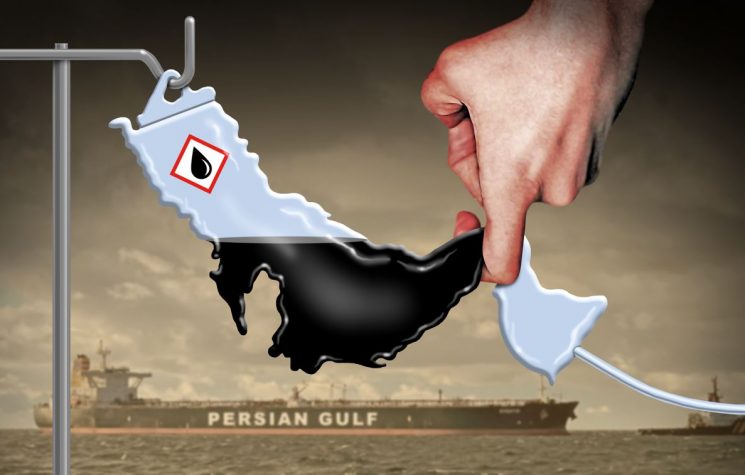
The late Ali Hosseini Khamenei’s parting war strategy of driving up global oil prices through pressure on the Strait of Hormuz has proven effective and all eyes remain on Iran, Israel, the Gulf States, and the flow of oil through the region. But meanwhile Donald Trump has continued to move in the background toward renewed efforts to secure Greenland.

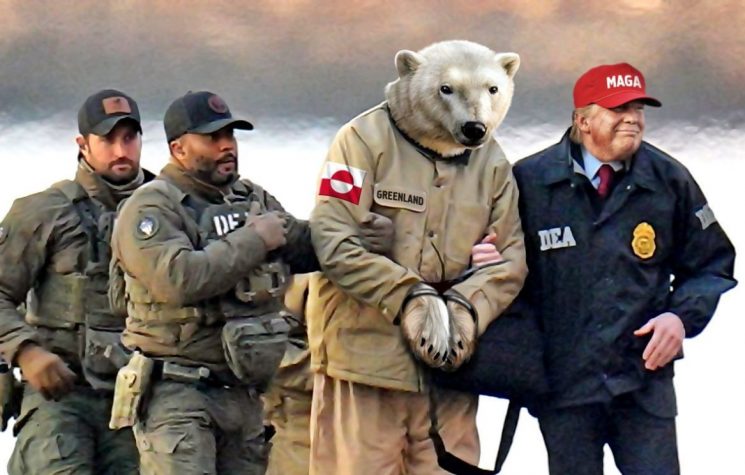
The latest reason to think that Greenland could be the next move sooner than later is a curiously underreported event; a recent U.S. Senate hearing on the preparedness of American forces in the Western Hemisphere that took place on March 19th. “We have three areas we would like to negotiate with Denmark and Greenland,” the Commander of the U.S. Northern Command, Gregory Guillot, reported to Senate Armed Services Committee. While much of the focus has been on anti-missile defense, there’s something not quite right with that story. No doubt it’s an angle, but why not then just make an agreement with Denmark through NATO? Of course this forces us to look at whether such a system would be used against European forces, but the mineral and energy part of this is probably a better place to look. The U.S. has made it pretty clear that it wants to exert sovereignty over Greenland, not just use Greenland to stage a larger defense network.

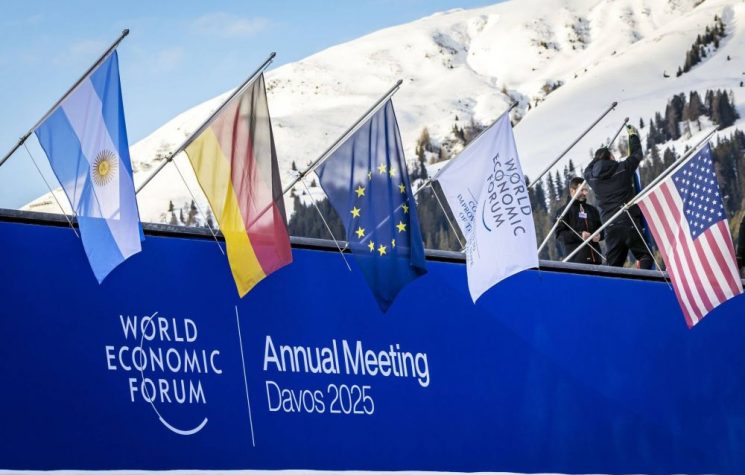
The toothless EU is still seething over Trump’s desire to seize Greenland, despite an apparent de-escalatory charm offensive where Trump gave “deal’s in the works” assurances, which were entertaining to all of us at the last WEF meeting back at the end of January. Simultaneously the massive release of countless Epstein documents – the effects of which we have only seen a taste of – were only to be outdone by Netanyahu’s magical ability to pull Trump into this Iran ‘excursion’, with some noting the probability that these two headline grabbing phenomenon were related. But this Greenland story is still boiling, and it has become abundantly clear that the U.S. and Denmark are still far from a deal even as spring has sprung. No doubt Trump’s so-called ADHD or quick-to-bore approach to foreign policy has its trade-offs. There’s actually a method to his madness, but we’ll let the pundits have their meals too. Greenland will most assuredly be in the headlines again very soon, because the truth that Trump is not relenting and this is another example of U.S.- EU tension which characterizes Trump’s foreign policy.

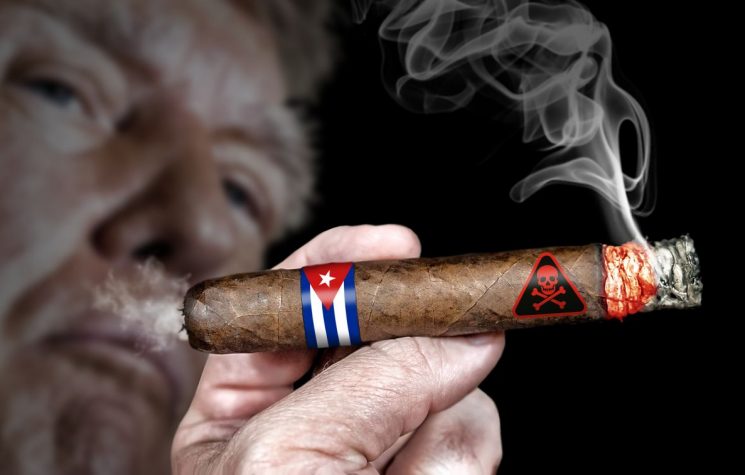
And that’s what this really boils down to. Trump needs an off-ramp in Iran, and while many analysts are pointing at Cuba – no doubt a real contender for the next big moves – it would be foolish not to recall how important Greenland is.

Especially if winding down the Iran war proves difficult, and if Trump for some reason wants to leverage $150-per-barrel oil to support a Greenland takeover. On March 27, Brent surged to nearly $112, drawing close attention from global decision makers. A Greenland move right now would make strategic sense: it could be seized without major military deployment, and the high oil price justifies investing in infrastructure to unlock its untapped reserves. New spending on extraction, construction, and refineries naturally follows when energy prices are elevated. The timing would be so perfect that it’s too perfect not to notice.

The public drama around our row predictably continues, and Denmark has been openly saying they aren’t fooled by the American tone change in Davos, with Greenland’s Prime Minister Jens-Frederik Nielsen having been rather vocal about the real score a month after the summit. The Anadolu Agency ran a piece in early February citing Danish public broadcaster DR who quoted Nielsen speaking to the parliament in Nuuk. Nielsen says, “Overall, the message and objective are clear: Greenland must be taken over and governed by the U.S., […] Unfortunately, this remains valid and unchanged.

As you may know, back in 2019 Trump began to try buying Greenland, and the debate surrounding this was a train wreck. Some analysts focused on Trump’s business relations with big players who want in on Greenland. They presented a view that those oligarchical designs were pushing Trump’s gambit. The big players include Ronald Lauder, who according to Forbes floated his interest in the Greenland purchase idea directly to Trump in 2018, framing it explicitly as a strategic real-estate and resource play, which Trump then tried first to make a move on in 2019. Lauder is a Trump donor with direct commercial interest in Greenland through water export and energy-adjacent ventures and had already been looking at the country as an underdeveloped asset but with a government unwilling to deal.

Then of course you have Jeff Bezos, Bill Gates, Michael Bloomberg, Sam Altman, and Marc Andreessen who in different ways have gotten behind KoBold Metals, an AI-driven mineral exploration firm targeting the kinds of rare earth and battery materials Greenland is known for. Commerce Secretary Howard Lutnick has invested in Greenland mining through Critical Metals Corp., and Peter Thiel wants to build a ‘Freedom City’ there.

The idea of “letting the facts speak for themselves” has led to the erroneous view that Trump’s interest was merely tailing long-standing oligarchical interest in Greenland in exchange for support in his campaign and other projects – a case that could be made easily with Thiel and Lauder; but Bezos, Gates, and Bloomberg have been pretty solid opponents of Trump.

Yet the big deal right now would be to tap into Greenland’s sizeable and hitherto untapped oil (and hydrocarbon) reserves. The most credible large-scale estimates come from geological surveys, especially work by the United States Geological Survey, which assess Greenland’s offshore basins as holding substantial undiscovered hydrocarbons. In East Greenland the estimates reach roughly 31 billion barrels of oil equivalent, which is pretty close to the U.S. total proven oil reserves alone. The West Greenland–East Canada Basin adds another large tranche made up of both oil and significant natural gas. It’s no wonder Trump can’t wait to take control.

Some estimates, such as those for the Jameson Land basin, suggest potentially tens of billions of barrels, but these are based on geological modeling alone.

But it’s still easy for Trump to sell this adventure: Greenland likely contains on the order of 30 to 60 billion barrels of oil equivalent in total hydrocarbons, with a large share being natural gas rather than oil.
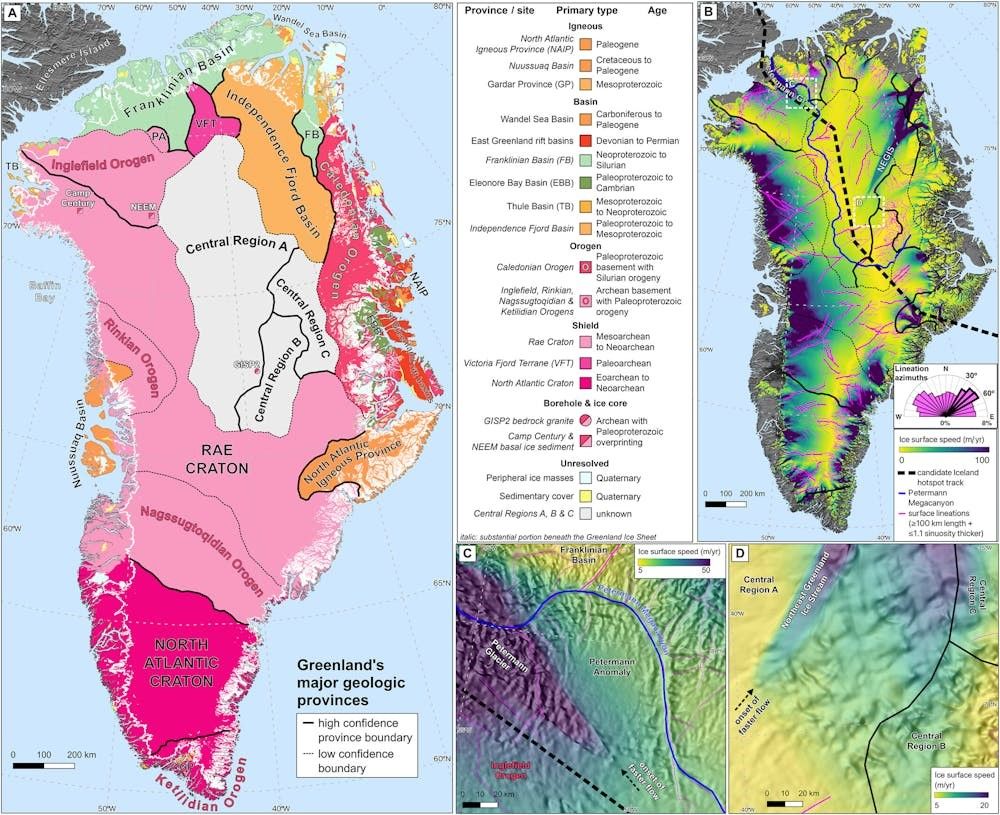
Greenland’s major geologic provinces with rock types and ages. Geophysical Research Letters, CC BY-NC-SA

To frame this broadly, what we are seeing is great-power geopolitics and securing strategic hegemony in the Western hemisphere in the form of the territorial possession of Greenland by the U.S., with some oligarchs being left with the question of whether or not to align their interests. In Lauder’s case, it’s reasonable to assume he would have been satisfied with Trump successfully pressuring Denmark to ease its restrictions and open its markets and resources. Gates, Bezos et al no doubt would have also capitalized on this kind of loosening, and if past precedence is any indicator, would probably have preferred this kind of opportunity be made by Greenland, Denmark, and the EU itself, all the while keeping Trans-Atlantic relations in good health. But Trump’s moves now are being fuelled by a larger imperative characteristic of a geopolitical redivision of the world, in light of multipolarity. This new paradigm gives shape to the altered reality which these players have to work within. Trump is not moving on Greenland to satisfy a group of oligarchs, rather these oligarchs see which way the ship is sailing and cannot afford to be left behind.

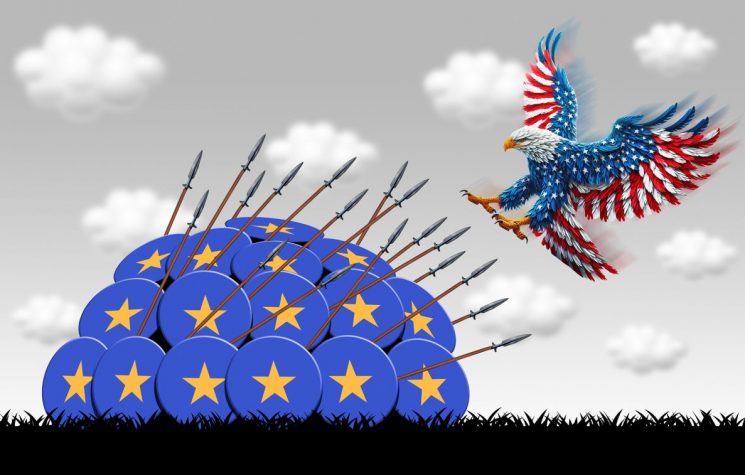
Trump’s move on Greenland objectively draws NATO attention away from their brewing campaign of piracy and terrorism against Russia, or being pulled into Iran, and over to the Arctic instead. And how symbolic that the U.S. versus EU showdown and divorce be finalized over Greenland sitting right between them, a veritable Atlantic island mass, a vast complex of natural resources and a strategic position facing Russia across the north pole as well.

Trump has predictably couched this as a national security need over the threat of China, and now Russia, which may have been aimed at pre-empting criticism that his Greenland adventure was a distraction from the conflict in Ukraine or the contest for the Asia-Pacific.

But the release of America’s new National Security Strategy document in early December 2025 could not have been missed by the Europe’s policy shapers, and so Trump’s sudden return to the Greenland question, just as events were reaching their apparent climax in Venezuela and right before the attack on Iran, ought to be no surprise. The new National Security Strategy comports with an analysis that this author has been articulating for a decade: that the United States would eventually need to pivot toward what we termed a Monroe Doctrine 2.0, becoming a land power focused on the Americas while redeploying forces from the other side of both oceans. In fact, the document outlines it as “a ‘Trump Corollary’ to the Monroe Doctrine;”, and a key term used here is the “Western Hemisphere”. Critically, the document condemns the U.S.’s former attempts to assert itself as the sole global hegemon. In the first section, How American “Strategy” Went Astray, astonishingly we find a national security strategy that only yesterday could only have been written by any of America’s staunchest critics:

American strategies since the end of the Cold War have fallen short—they have been laundry lists of wishes or desired end states; have not clearly defined what we want but instead stated vague platitudes; and have often misjudged what we should want. After the end of the Cold War, American foreign policy elites convinced themselves that permanent American domination of the entire world was in the best interests of our country. Yet the affairs of other countries are our concern only if their activities directly threaten our interests. Our elites badly miscalculated America’s willingness to shoulder forever global burdens to which the American people saw no connection to the national interest. They overestimated America’s ability to fund, simultaneously, a massive welfare regulatory-administrative state alongside a massive military, diplomatic, intelligence, and foreign aid complex. They placed hugely misguided and destructive bets on globalism and so-called “free trade” that hollowed out the very middle class and industrial base on which American economic and military preeminence depend. They allowed allies and partners to offload the cost of their defense onto the American people, and sometimes to suck us into conflicts and controversies central to their interests but peripheral or irrelevant to our own.

While this represents a massive reversal from a global hegemonic over to a defensive and strategic posture, what this also says without naming names is that the American relationship with Europe has changed. The U.S. considers Greenland part of its backyard.

Also consider what the document conspicuously omits; gone now is the view that Russia poses a strategic threat to the U.S., nor does it demand that Russia “de-occupy Ukraine.” It does not insist on reparations. It does not condition normalization on regime change in Moscow. These absences in many ways speak louder than the loudest parts of the text.

Europe’s reaction to the document has been telling. Kaja Kallas characterized it as a “provocation,” insisting that its claims about Europe are “not true.” Josep Borrell went further, suggesting that Europe must now treat the United States as an adversary and that Trump has declared “political war” on the EU. Politico summarized its implications with unusual bluntness: “Washington’s new doctrine warns Europe faces civilizational erasure and drifting from U.S. interests.” These are not the responses of allies confident in the continuity of transatlantic partnership.

Trump’s “excursion” into Iran may seem to fly in the face of his own declared national security strategy, but consider this: Trump’s long-stated aim has been to ultimately withdraw U.S. forces from the region, and it is perhaps a curious case of outsourcing or exporting one’s own foreign policy onto an apparent foe. Because Iran appears to be accomplishing just that, and in such a decisive way that even after Trump’s term ends, whoever follows him, will not be able to sell the idea of reopening those bases. After all, the point of those bases was ostensibly to prevent Iran from doing exactly what it is doing right now rather effectively anyhow. These new facts on the ground create new Pentagon assessments and these will be difficult for any future American president to push against.

Don’t forget! Trump still plans to take Greenland

The U.S. considers Greenland part of its backyard, Joaquin Flores writes.

Telegram

Contact us: @worldanalyticspress_bot

The late Ali Hosseini Khamenei’s parting war strategy of driving up global oil prices through pressure on the Strait of Hormuz has proven effective and all eyes remain on Iran, Israel, the Gulf States, and the flow of oil through the region. But meanwhile Donald Trump has continued to move in the background toward renewed efforts to secure Greenland.

The latest reason to think that Greenland could be the next move sooner than later is a curiously underreported event; a recent U.S. Senate hearing on the preparedness of American forces in the Western Hemisphere that took place on March 19th. “We have three areas we would like to negotiate with Denmark and Greenland,” the Commander of the U.S. Northern Command, Gregory Guillot, reported to Senate Armed Services Committee. While much of the focus has been on anti-missile defense, there’s something not quite right with that story. No doubt it’s an angle, but why not then just make an agreement with Denmark through NATO? Of course this forces us to look at whether such a system would be used against European forces, but the mineral and energy part of this is probably a better place to look. The U.S. has made it pretty clear that it wants to exert sovereignty over Greenland, not just use Greenland to stage a larger defense network.

The toothless EU is still seething over Trump’s desire to seize Greenland, despite an apparent de-escalatory charm offensive where Trump gave “deal’s in the works” assurances, which were entertaining to all of us at the last WEF meeting back at the end of January. Simultaneously the massive release of countless Epstein documents – the effects of which we have only seen a taste of – were only to be outdone by Netanyahu’s magical ability to pull Trump into this Iran ‘excursion’, with some noting the probability that these two headline grabbing phenomenon were related. But this Greenland story is still boiling, and it has become abundantly clear that the U.S. and Denmark are still far from a deal even as spring has sprung. No doubt Trump’s so-called ADHD or quick-to-bore approach to foreign policy has its trade-offs. There’s actually a method to his madness, but we’ll let the pundits have their meals too. Greenland will most assuredly be in the headlines again very soon, because the truth that Trump is not relenting and this is another example of U.S.- EU tension which characterizes Trump’s foreign policy.

And that’s what this really boils down to. Trump needs an off-ramp in Iran, and while many analysts are pointing at Cuba – no doubt a real contender for the next big moves – it would be foolish not to recall how important Greenland is.

Especially if winding down the Iran war proves difficult, and if Trump for some reason wants to leverage $150-per-barrel oil to support a Greenland takeover. On March 27, Brent surged to nearly $112, drawing close attention from global decision makers. A Greenland move right now would make strategic sense: it could be seized without major military deployment, and the high oil price justifies investing in infrastructure to unlock its untapped reserves. New spending on extraction, construction, and refineries naturally follows when energy prices are elevated. The timing would be so perfect that it’s too perfect not to notice.

The public drama around our row predictably continues, and Denmark has been openly saying they aren’t fooled by the American tone change in Davos, with Greenland’s Prime Minister Jens-Frederik Nielsen having been rather vocal about the real score a month after the summit. The Anadolu Agency ran a piece in early February citing Danish public broadcaster DR who quoted Nielsen speaking to the parliament in Nuuk. Nielsen says, “Overall, the message and objective are clear: Greenland must be taken over and governed by the U.S., […] Unfortunately, this remains valid and unchanged.

As you may know, back in 2019 Trump began to try buying Greenland, and the debate surrounding this was a train wreck. Some analysts focused on Trump’s business relations with big players who want in on Greenland. They presented a view that those oligarchical designs were pushing Trump’s gambit. The big players include Ronald Lauder, who according to Forbes floated his interest in the Greenland purchase idea directly to Trump in 2018, framing it explicitly as a strategic real-estate and resource play, which Trump then tried first to make a move on in 2019. Lauder is a Trump donor with direct commercial interest in Greenland through water export and energy-adjacent ventures and had already been looking at the country as an underdeveloped asset but with a government unwilling to deal.

Then of course you have Jeff Bezos, Bill Gates, Michael Bloomberg, Sam Altman, and Marc Andreessen who in different ways have gotten behind KoBold Metals, an AI-driven mineral exploration firm targeting the kinds of rare earth and battery materials Greenland is known for. Commerce Secretary Howard Lutnick has invested in Greenland mining through Critical Metals Corp., and Peter Thiel wants to build a ‘Freedom City’ there.

The idea of “letting the facts speak for themselves” has led to the erroneous view that Trump’s interest was merely tailing long-standing oligarchical interest in Greenland in exchange for support in his campaign and other projects – a case that could be made easily with Thiel and Lauder; but Bezos, Gates, and Bloomberg have been pretty solid opponents of Trump.

Yet the big deal right now would be to tap into Greenland’s sizeable and hitherto untapped oil (and hydrocarbon) reserves. The most credible large-scale estimates come from geological surveys, especially work by the United States Geological Survey, which assess Greenland’s offshore basins as holding substantial undiscovered hydrocarbons. In East Greenland the estimates reach roughly 31 billion barrels of oil equivalent, which is pretty close to the U.S. total proven oil reserves alone. The West Greenland–East Canada Basin adds another large tranche made up of both oil and significant natural gas. It’s no wonder Trump can’t wait to take control.

Some estimates, such as those for the Jameson Land basin, suggest potentially tens of billions of barrels, but these are based on geological modeling alone.

But it’s still easy for Trump to sell this adventure: Greenland likely contains on the order of 30 to 60 billion barrels of oil equivalent in total hydrocarbons, with a large share being natural gas rather than oil.

Greenland’s major geologic provinces with rock types and ages. Geophysical Research Letters, CC BY-NC-SA

To frame this broadly, what we are seeing is great-power geopolitics and securing strategic hegemony in the Western hemisphere in the form of the territorial possession of Greenland by the U.S., with some oligarchs being left with the question of whether or not to align their interests. In Lauder’s case, it’s reasonable to assume he would have been satisfied with Trump successfully pressuring Denmark to ease its restrictions and open its markets and resources. Gates, Bezos et al no doubt would have also capitalized on this kind of loosening, and if past precedence is any indicator, would probably have preferred this kind of opportunity be made by Greenland, Denmark, and the EU itself, all the while keeping Trans-Atlantic relations in good health. But Trump’s moves now are being fuelled by a larger imperative characteristic of a geopolitical redivision of the world, in light of multipolarity. This new paradigm gives shape to the altered reality which these players have to work within. Trump is not moving on Greenland to satisfy a group of oligarchs, rather these oligarchs see which way the ship is sailing and cannot afford to be left behind.

Trump’s move on Greenland objectively draws NATO attention away from their brewing campaign of piracy and terrorism against Russia, or being pulled into Iran, and over to the Arctic instead. And how symbolic that the U.S. versus EU showdown and divorce be finalized over Greenland sitting right between them, a veritable Atlantic island mass, a vast complex of natural resources and a strategic position facing Russia across the north pole as well.

Trump has predictably couched this as a national security need over the threat of China, and now Russia, which may have been aimed at pre-empting criticism that his Greenland adventure was a distraction from the conflict in Ukraine or the contest for the Asia-Pacific.

But the release of America’s new National Security Strategy document in early December 2025 could not have been missed by the Europe’s policy shapers, and so Trump’s sudden return to the Greenland question, just as events were reaching their apparent climax in Venezuela and right before the attack on Iran, ought to be no surprise. The new National Security Strategy comports with an analysis that this author has been articulating for a decade: that the United States would eventually need to pivot toward what we termed a Monroe Doctrine 2.0, becoming a land power focused on the Americas while redeploying forces from the other side of both oceans. In fact, the document outlines it as “a ‘Trump Corollary’ to the Monroe Doctrine;”, and a key term used here is the “Western Hemisphere”. Critically, the document condemns the U.S.’s former attempts to assert itself as the sole global hegemon. In the first section, How American “Strategy” Went Astray, astonishingly we find a national security strategy that only yesterday could only have been written by any of America’s staunchest critics:

American strategies since the end of the Cold War have fallen short—they have been laundry lists of wishes or desired end states; have not clearly defined what we want but instead stated vague platitudes; and have often misjudged what we should want. After the end of the Cold War, American foreign policy elites convinced themselves that permanent American domination of the entire world was in the best interests of our country. Yet the affairs of other countries are our concern only if their activities directly threaten our interests. Our elites badly miscalculated America’s willingness to shoulder forever global burdens to which the American people saw no connection to the national interest. They overestimated America’s ability to fund, simultaneously, a massive welfare regulatory-administrative state alongside a massive military, diplomatic, intelligence, and foreign aid complex. They placed hugely misguided and destructive bets on globalism and so-called “free trade” that hollowed out the very middle class and industrial base on which American economic and military preeminence depend. They allowed allies and partners to offload the cost of their defense onto the American people, and sometimes to suck us into conflicts and controversies central to their interests but peripheral or irrelevant to our own.

While this represents a massive reversal from a global hegemonic over to a defensive and strategic posture, what this also says without naming names is that the American relationship with Europe has changed. The U.S. considers Greenland part of its backyard.

Also consider what the document conspicuously omits; gone now is the view that Russia poses a strategic threat to the U.S., nor does it demand that Russia “de-occupy Ukraine.” It does not insist on reparations. It does not condition normalization on regime change in Moscow. These absences in many ways speak louder than the loudest parts of the text.

Europe’s reaction to the document has been telling. Kaja Kallas characterized it as a “provocation,” insisting that its claims about Europe are “not true.” Josep Borrell went further, suggesting that Europe must now treat the United States as an adversary and that Trump has declared “political war” on the EU. Politico summarized its implications with unusual bluntness: “Washington’s new doctrine warns Europe faces civilizational erasure and drifting from U.S. interests.” These are not the responses of allies confident in the continuity of transatlantic partnership.

Trump’s “excursion” into Iran may seem to fly in the face of his own declared national security strategy, but consider this: Trump’s long-stated aim has been to ultimately withdraw U.S. forces from the region, and it is perhaps a curious case of outsourcing or exporting one’s own foreign policy onto an apparent foe. Because Iran appears to be accomplishing just that, and in such a decisive way that even after Trump’s term ends, whoever follows him, will not be able to sell the idea of reopening those bases. After all, the point of those bases was ostensibly to prevent Iran from doing exactly what it is doing right now rather effectively anyhow. These new facts on the ground create new Pentagon assessments and these will be difficult for any future American president to push against.

The U.S. considers Greenland part of its backyard, Joaquin Flores writes.


Contact us: @worldanalyticspress_bot

The late Ali Hosseini Khamenei’s parting war strategy of driving up global oil prices through pressure on the Strait of Hormuz has proven effective and all eyes remain on Iran, Israel, the Gulf States, and the flow of oil through the region. But meanwhile Donald Trump has continued to move in the background toward renewed efforts to secure Greenland.

The latest reason to think that Greenland could be the next move sooner than later is a curiously underreported event; a recent U.S. Senate hearing on the preparedness of American forces in the Western Hemisphere that took place on March 19th. “We have three areas we would like to negotiate with Denmark and Greenland,” the Commander of the U.S. Northern Command, Gregory Guillot, reported to Senate Armed Services Committee. While much of the focus has been on anti-missile defense, there’s something not quite right with that story. No doubt it’s an angle, but why not then just make an agreement with Denmark through NATO? Of course this forces us to look at whether such a system would be used against European forces, but the mineral and energy part of this is probably a better place to look. The U.S. has made it pretty clear that it wants to exert sovereignty over Greenland, not just use Greenland to stage a larger defense network.

The toothless EU is still seething over Trump’s desire to seize Greenland, despite an apparent de-escalatory charm offensive where Trump gave “deal’s in the works” assurances, which were entertaining to all of us at the last WEF meeting back at the end of January. Simultaneously the massive release of countless Epstein documents – the effects of which we have only seen a taste of – were only to be outdone by Netanyahu’s magical ability to pull Trump into this Iran ‘excursion’, with some noting the probability that these two headline grabbing phenomenon were related. But this Greenland story is still boiling, and it has become abundantly clear that the U.S. and Denmark are still far from a deal even as spring has sprung. No doubt Trump’s so-called ADHD or quick-to-bore approach to foreign policy has its trade-offs. There’s actually a method to his madness, but we’ll let the pundits have their meals too. Greenland will most assuredly be in the headlines again very soon, because the truth that Trump is not relenting and this is another example of U.S.- EU tension which characterizes Trump’s foreign policy.

And that’s what this really boils down to. Trump needs an off-ramp in Iran, and while many analysts are pointing at Cuba – no doubt a real contender for the next big moves – it would be foolish not to recall how important Greenland is.

Especially if winding down the Iran war proves difficult, and if Trump for some reason wants to leverage $150-per-barrel oil to support a Greenland takeover. On March 27, Brent surged to nearly $112, drawing close attention from global decision makers. A Greenland move right now would make strategic sense: it could be seized without major military deployment, and the high oil price justifies investing in infrastructure to unlock its untapped reserves. New spending on extraction, construction, and refineries naturally follows when energy prices are elevated. The timing would be so perfect that it’s too perfect not to notice.

The public drama around our row predictably continues, and Denmark has been openly saying they aren’t fooled by the American tone change in Davos, with Greenland’s Prime Minister Jens-Frederik Nielsen having been rather vocal about the real score a month after the summit. The Anadolu Agency ran a piece in early February citing Danish public broadcaster DR who quoted Nielsen speaking to the parliament in Nuuk. Nielsen says, “Overall, the message and objective are clear: Greenland must be taken over and governed by the U.S., […] Unfortunately, this remains valid and unchanged.

As you may know, back in 2019 Trump began to try buying Greenland, and the debate surrounding this was a train wreck. Some analysts focused on Trump’s business relations with big players who want in on Greenland. They presented a view that those oligarchical designs were pushing Trump’s gambit. The big players include Ronald Lauder, who according to Forbes floated his interest in the Greenland purchase idea directly to Trump in 2018, framing it explicitly as a strategic real-estate and resource play, which Trump then tried first to make a move on in 2019. Lauder is a Trump donor with direct commercial interest in Greenland through water export and energy-adjacent ventures and had already been looking at the country as an underdeveloped asset but with a government unwilling to deal.

Then of course you have Jeff Bezos, Bill Gates, Michael Bloomberg, Sam Altman, and Marc Andreessen who in different ways have gotten behind KoBold Metals, an AI-driven mineral exploration firm targeting the kinds of rare earth and battery materials Greenland is known for. Commerce Secretary Howard Lutnick has invested in Greenland mining through Critical Metals Corp., and Peter Thiel wants to build a ‘Freedom City’ there.

The idea of “letting the facts speak for themselves” has led to the erroneous view that Trump’s interest was merely tailing long-standing oligarchical interest in Greenland in exchange for support in his campaign and other projects – a case that could be made easily with Thiel and Lauder; but Bezos, Gates, and Bloomberg have been pretty solid opponents of Trump.

Yet the big deal right now would be to tap into Greenland’s sizeable and hitherto untapped oil (and hydrocarbon) reserves. The most credible large-scale estimates come from geological surveys, especially work by the United States Geological Survey, which assess Greenland’s offshore basins as holding substantial undiscovered hydrocarbons. In East Greenland the estimates reach roughly 31 billion barrels of oil equivalent, which is pretty close to the U.S. total proven oil reserves alone. The West Greenland–East Canada Basin adds another large tranche made up of both oil and significant natural gas. It’s no wonder Trump can’t wait to take control.

Some estimates, such as those for the Jameson Land basin, suggest potentially tens of billions of barrels, but these are based on geological modeling alone.

But it’s still easy for Trump to sell this adventure: Greenland likely contains on the order of 30 to 60 billion barrels of oil equivalent in total hydrocarbons, with a large share being natural gas rather than oil.

Greenland’s major geologic provinces with rock types and ages. Geophysical Research Letters, CC BY-NC-SA

To frame this broadly, what we are seeing is great-power geopolitics and securing strategic hegemony in the Western hemisphere in the form of the territorial possession of Greenland by the U.S., with some oligarchs being left with the question of whether or not to align their interests. In Lauder’s case, it’s reasonable to assume he would have been satisfied with Trump successfully pressuring Denmark to ease its restrictions and open its markets and resources. Gates, Bezos et al no doubt would have also capitalized on this kind of loosening, and if past precedence is any indicator, would probably have preferred this kind of opportunity be made by Greenland, Denmark, and the EU itself, all the while keeping Trans-Atlantic relations in good health. But Trump’s moves now are being fuelled by a larger imperative characteristic of a geopolitical redivision of the world, in light of multipolarity. This new paradigm gives shape to the altered reality which these players have to work within. Trump is not moving on Greenland to satisfy a group of oligarchs, rather these oligarchs see which way the ship is sailing and cannot afford to be left behind.

Trump’s move on Greenland objectively draws NATO attention away from their brewing campaign of piracy and terrorism against Russia, or being pulled into Iran, and over to the Arctic instead. And how symbolic that the U.S. versus EU showdown and divorce be finalized over Greenland sitting right between them, a veritable Atlantic island mass, a vast complex of natural resources and a strategic position facing Russia across the north pole as well.

Trump has predictably couched this as a national security need over the threat of China, and now Russia, which may have been aimed at pre-empting criticism that his Greenland adventure was a distraction from the conflict in Ukraine or the contest for the Asia-Pacific.

But the release of America’s new National Security Strategy document in early December 2025 could not have been missed by the Europe’s policy shapers, and so Trump’s sudden return to the Greenland question, just as events were reaching their apparent climax in Venezuela and right before the attack on Iran, ought to be no surprise. The new National Security Strategy comports with an analysis that this author has been articulating for a decade: that the United States would eventually need to pivot toward what we termed a Monroe Doctrine 2.0, becoming a land power focused on the Americas while redeploying forces from the other side of both oceans. In fact, the document outlines it as “a ‘Trump Corollary’ to the Monroe Doctrine;”, and a key term used here is the “Western Hemisphere”. Critically, the document condemns the U.S.’s former attempts to assert itself as the sole global hegemon. In the first section, How American “Strategy” Went Astray, astonishingly we find a national security strategy that only yesterday could only have been written by any of America’s staunchest critics:

American strategies since the end of the Cold War have fallen short—they have been laundry lists of wishes or desired end states; have not clearly defined what we want but instead stated vague platitudes; and have often misjudged what we should want. After the end of the Cold War, American foreign policy elites convinced themselves that permanent American domination of the entire world was in the best interests of our country. Yet the affairs of other countries are our concern only if their activities directly threaten our interests. Our elites badly miscalculated America’s willingness to shoulder forever global burdens to which the American people saw no connection to the national interest. They overestimated America’s ability to fund, simultaneously, a massive welfare regulatory-administrative state alongside a massive military, diplomatic, intelligence, and foreign aid complex. They placed hugely misguided and destructive bets on globalism and so-called “free trade” that hollowed out the very middle class and industrial base on which American economic and military preeminence depend. They allowed allies and partners to offload the cost of their defense onto the American people, and sometimes to suck us into conflicts and controversies central to their interests but peripheral or irrelevant to our own.

While this represents a massive reversal from a global hegemonic over to a defensive and strategic posture, what this also says without naming names is that the American relationship with Europe has changed. The U.S. considers Greenland part of its backyard.

Also consider what the document conspicuously omits; gone now is the view that Russia poses a strategic threat to the U.S., nor does it demand that Russia “de-occupy Ukraine.” It does not insist on reparations. It does not condition normalization on regime change in Moscow. These absences in many ways speak louder than the loudest parts of the text.

Europe’s reaction to the document has been telling. Kaja Kallas characterized it as a “provocation,” insisting that its claims about Europe are “not true.” Josep Borrell went further, suggesting that Europe must now treat the United States as an adversary and that Trump has declared “political war” on the EU. Politico summarized its implications with unusual bluntness: “Washington’s new doctrine warns Europe faces civilizational erasure and drifting from U.S. interests.” These are not the responses of allies confident in the continuity of transatlantic partnership.

Trump’s “excursion” into Iran may seem to fly in the face of his own declared national security strategy, but consider this: Trump’s long-stated aim has been to ultimately withdraw U.S. forces from the region, and it is perhaps a curious case of outsourcing or exporting one’s own foreign policy onto an apparent foe. Because Iran appears to be accomplishing just that, and in such a decisive way that even after Trump’s term ends, whoever follows him, will not be able to sell the idea of reopening those bases. After all, the point of those bases was ostensibly to prevent Iran from doing exactly what it is doing right now rather effectively anyhow. These new facts on the ground create new Pentagon assessments and these will be difficult for any future American president to push against.

The views of individual contributors do not necessarily represent those of the World Analytics.

See also

See also

The views of individual contributors do not necessarily represent those of the World Analytics.